by Erika Nesvold | Oct 17, 2013 | Daily Paper Summaries
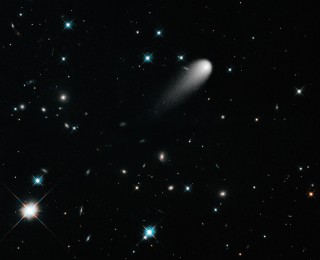
Comet ISON will be flying by on its way from the Oort Cloud to the Sun and back for the next couple months. Will the meteoroids it leaves behind produce any meteor showers here on Earth? The authors of this paper use orbital mechanics to find out.
by Erika Nesvold | Sep 19, 2013 | Daily Paper Summaries
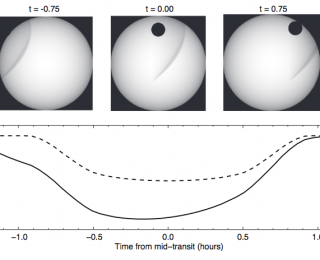
Transit observations can yield a lot of information about exoplanets. If a transiting exoplanet encounters stellar wind, the bow shock created can show up in the transit light curves. In this paper, the authors investigate how the stellar wind of a star can shape the light curves we observe.
by Erika Nesvold | Aug 22, 2013 | Daily Paper Summaries
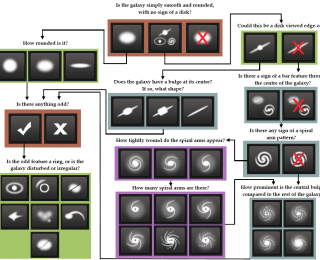
Galaxy Zoo is a citizen science project that uses volunteers to classify galaxies from the Sloan Digitial Sky Survey as spiral or elliptical. Now the Galaxy Zoo 2 catalogue has gone public, with even more detailed classifications of galaxies, including bars, bulges, spiral arms, and round and squashed ellipticals.
by Erika Nesvold | Jul 25, 2013 | Daily Paper Summaries
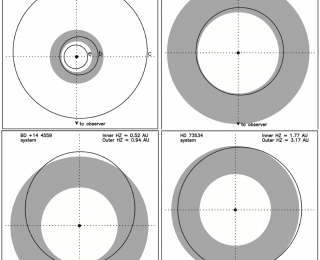
The search for exoplanets in their habitable zones continues. But exomoons could be habitable, too! This paper models hypothetical exomoons in four real systems to determine the habitability of moons around planets that don’t necessarily stay in the habitable zone.
by Erika Nesvold | Jun 27, 2013 | Daily Paper Summaries
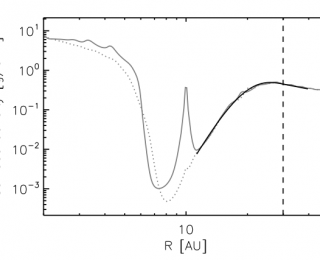
The mass of a substellar companion can help determine whether it’s a planet or a brown dwarf. But how can you measure the mass of a companion that you can’t detect directly? Look at the disk!
