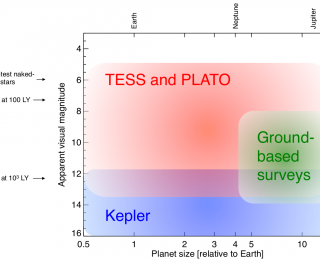
The Next Transit Hunters
The exoplanet hunt is on. The stakes are high. What will our next-generation telescopes find?

The exoplanet hunt is on. The stakes are high. What will our next-generation telescopes find?
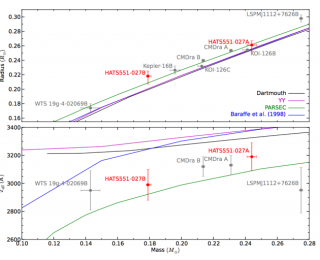
Very low-mass M-dwarfs are a missing link in our theory of stellar interiors. Stars this small probably have fully convective interiors, but we don’t have a complete understanding of how that affects global properties like radius or temperature. It’s important to get right, if for no other reason because lots of exoplanets orbit M-dwarfs.
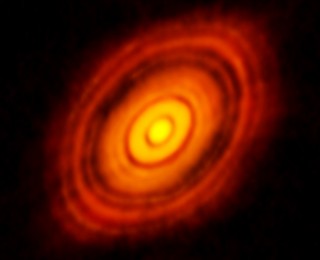
The authors of today’s paper show that the locations of the protoplanetary gaps in HL Tau are to be expected from the condensation points of common ices in the disk.
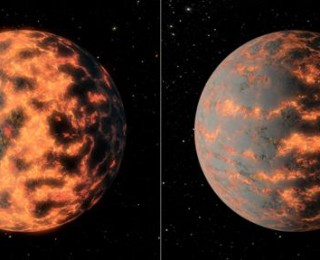
Of the more than 1500 exoplanets discovered over the past two decades, perhaps the most intriguing and unexpected have been the ultra-short period planets, worlds so close to their parent star that they complete an entire orbit in less than a day. Most are small, less than twice the radius of the Earth, and are so hot that their rocky crusts are being melted away. The debris could be used to investigate the composition of these mysterious worlds, but most of them are too small for our current instruments to observe in detail.
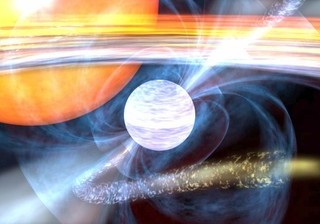
Pulsars, or rapidly-spinning neutron stars, have been observed to suddenly change in spin. Typically, the pulsars we’ve seen do this are isolated—what happens if they have a stellar companion?

What were the first galaxies in the Universe like? Current observations can only access a handful of these ancients. However, a new simulation has synthesized millions to better understand the galaxies of 13 billion years ago.