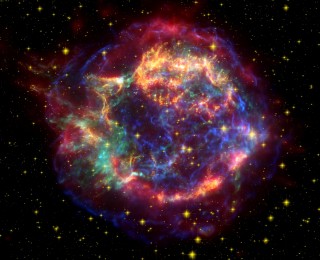
CSI: Universe
A supernova goes off. A star has died. Can its partner have anything to do with it?

A supernova goes off. A star has died. Can its partner have anything to do with it?
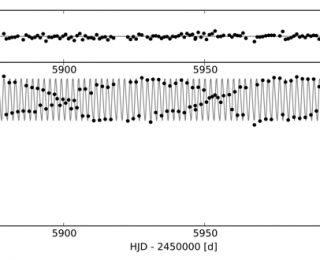
Cepheids’ pulsing brightness variations happen because the star’s temperature and radius is changing, and they occupy a unique niche of stellar evolution. We can learn a lot about what is physically happening inside stars during this tumultuous time through close observations. Or rather, we could learn a lot about what happens inside Cepheid variable stars, if only we knew their masses.
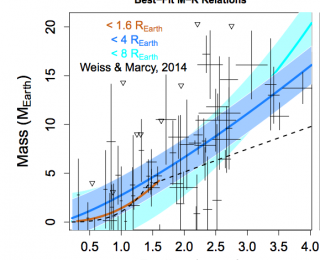
Thousands of transiting exoplanets have been discovered, but for most of these planets we only know their radius and nothing about their mass. With a mass-radius relation, we can infer the masses of all these planets. This paper provides a new, probabilistic mass-radius relation for small planets, and its approach is somewhat unusual…
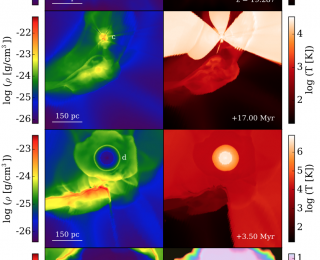
Stars formed in the early Universe were extremely massive and extremely low in elements heavier than helium. The transition from the first to the second generation of stars is still hidden in the shadows of the past. However, simulations of the most massive supernovae can help us to decipher the way of how the life cycle of stars came into being.
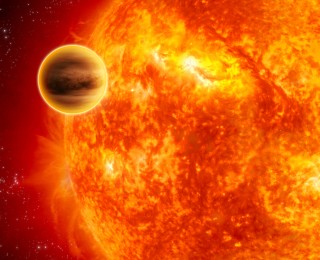
Although this planet is far from habitable, scientists have confirmed the presence of water vapor in the atmosphere of the WASP-12 system. What does this infer about its planetary atmosphere? Is this in agreement with other studies? The story is not as black and white as we might have thought.
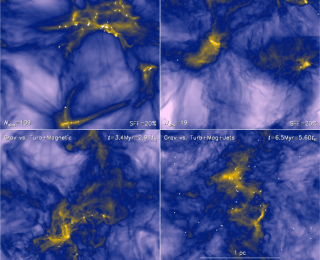
Stars form via gravitational collapse of molecular cloud cores. But observations reveal that far less gas is turned into stars than you would suspect by naively calculating the star formation rate. So what can we do about this mismatch?