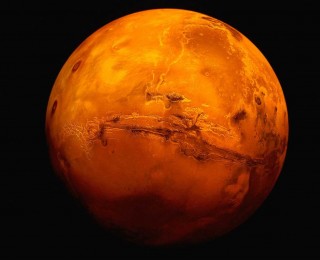
Could Mars have experienced a colossal global warming?
How is it possible that our coldest and closest neighbor once sustained liquid water 3.8 billion years ago?? Here’s one possibility…

How is it possible that our coldest and closest neighbor once sustained liquid water 3.8 billion years ago?? Here’s one possibility…
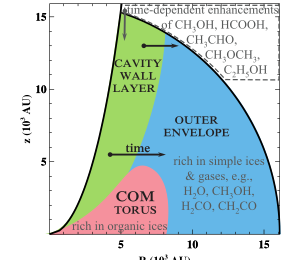
Advanced observational tools such as ALMA allow the detection of complex organic molecules – the building blocks of life. However, how and where they are formed is still unknown.
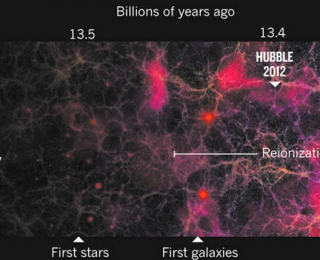
Cosmic reionization is a period in the Universe history when it switched from being predominantly neutral to mostly ionized. We still haven’t quite pinned down the source(s) that caused this transition, but we have our suspicions. It could be quasars. It could be galaxies. Or could it be something else?
[Figure from universe-review.ca/F05-galaxy06.htm]
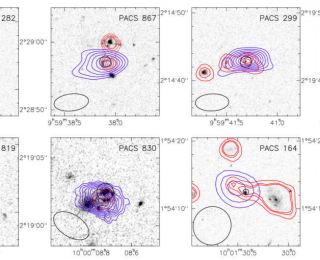
How efficiently can a galaxy turn gas into stars? Most galaxies do so at a very typical rate, but some convert gas incredibly fast in a huge starburst – but how efficient can they get?
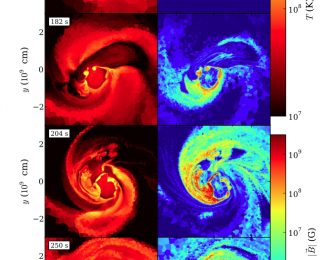
White dwarfs in a binary often merge into a variety of interesting phenomena. However, nobody has sought to understand the role that magnetic fields play during the merger. The authors simulate the merging of two white dwarfs with magnetic fields to see what happens.
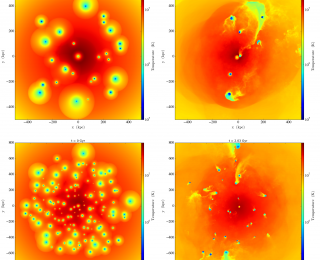
The evolution of a galaxy is strongly dependent upon the environment the galaxy lives in. Galaxies moving through galaxy groups and galaxy clusters can get stripped of their gas that would otherwise be used to form stars. Today’s astrobite discusses simulations of the stripping and removal of the hot, gaseous coronae that surround galaxies.