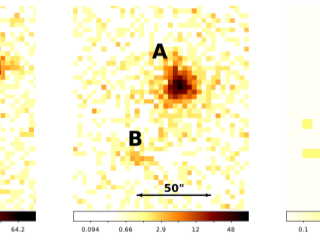
Hot Jupiters and Their Effects on Host Stars
Hot Jupiters offer an interesting mechanism for affecting the rotation and magnetic activity levels of their host stars.

Hot Jupiters offer an interesting mechanism for affecting the rotation and magnetic activity levels of their host stars.
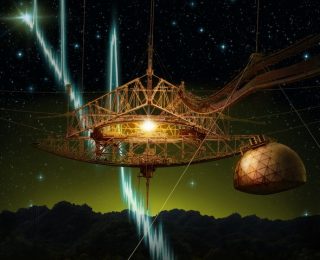
A mysterious Fast Radio Burst (FRB) from beyond the galaxy has been detected at Arecibo. This is the first FRB discovered outside of Parkes Observatory, giving greater credence to the astronomical nature of these signals.
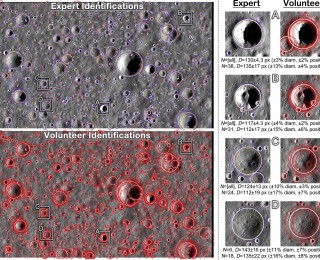
How good are citizen-scientists at characterizing crater densities and size distributions on the lunar surface? For that matter how good are the experts? Today’s study attempts to answer these questions by having a group of experts analyze images of the Moon from the Lunar Reconnaissance Orbiter Camera.
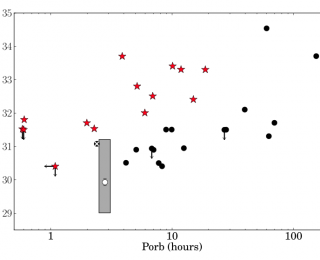
The authors report the discovery of perhaps the faintest black hole x-ray binary. But this conclusion is limited by the uncertainty in the distance to the object.
Orbiting our galaxy are many smaller dwarf galaxies. As they orbit, some of these galaxies produce vast streams of gas that stretch around our Milky Way galaxy. Much of this gas still has the potential for forming stars. This astrobite will summarize a recent discovery of one of these stars.
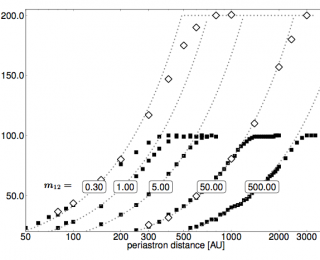
A close encounter with another star can disrupt the protoplanetary disk of a young star, leaving a smaller disk behind. Can we learn anything about the encounter from the size of the remaining disk? Read on to find out!