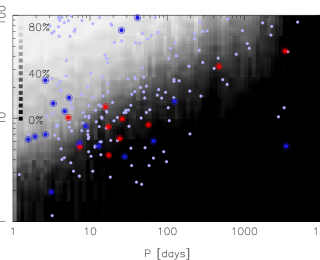
A Planet for Every M Dwarf Star?
A recent result on the commonality of exoplanets has made headlines, but has it for the right reasons?

A recent result on the commonality of exoplanets has made headlines, but has it for the right reasons?
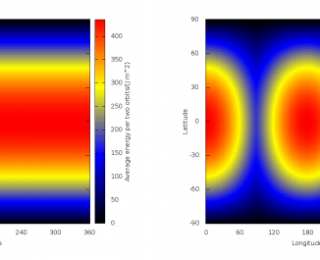
Planets orbiting close to type-M dwarf stars are in the habitable zone, but if their orbits are in a 3:2 spin resonance, do their long, strange days and nights have a chance of supporting photosynthetic life?
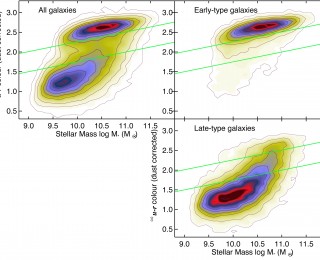
Large surveys of galaxies have revealed a bimodal color distribution: most galaxies tend to be red or blue, leaving a gap in the middle known as the green valley. The authors of this paper use morphologies provided by the Galaxy Zoo project to show that not all galaxies take the same quick path through the green valley.
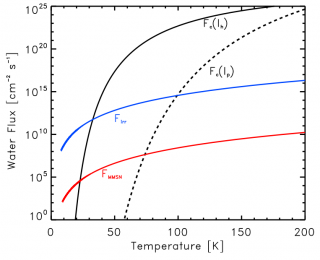
The formation of water ice is an important first step in the formation of our Solar System. We review the process of early water ice formation and the difference between crystalline and amorphous water ice.
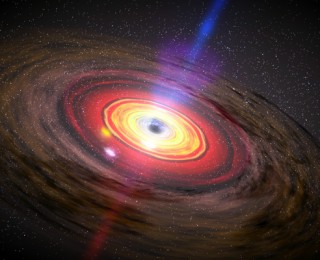
By looking at the spectral changes of the accretion disk emission around black holes, we can trace the physical changes of the accreting material.
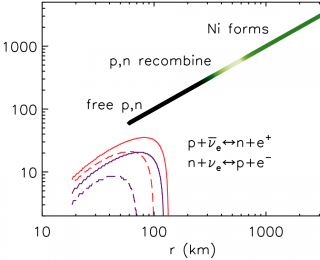
There aren’t many places in the universe that you can find a bunch of free neutrons not already trapped inside a nucleus—except in neutron stars. Luckily, neutron stars in violent mergers with other neutron stars, or with black holes, tend to disperse a little bit of their matter into the interstellar medium. Tidal forces eject some matter as the two objects swing around each other in their final orbits. Then, if an accretion disk forms, winds blown off the surface of the disk disperse even more matter. Surman and her colleagues look at the nucleosynthesis that occurs in this latter process, and find something surprising.