by Yvette Cendes | Feb 21, 2014 | Daily Paper Summaries
Astronomers are hearing a new type of radio transient, but no one knows where they come from and how they are created. This paper suggests one of the six documented Fast Radio Bursts detected so far originated close to home, within our own galaxy.
by Becky Smethurst | Feb 20, 2014 | Daily Paper Summaries
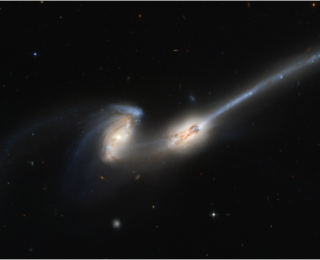
Every galaxy is thought to contain a black hole at the centre – but why are some active and some not? What process has ‘switched-on’ these active galaxies? Theorists suggest that major galaxy mergers could play a part for the highly luminous active galaxies but we’re currently lacking conclusive observational evidence to support this theory.
by Meredith Rawls | Feb 17, 2014 | Daily Paper Summaries
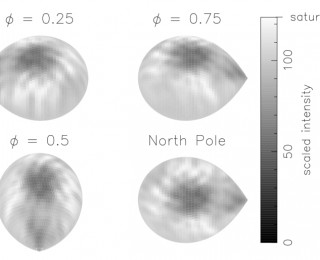
What do you call two stars hurtling around each other with bursts of X-rays every few decades? An X-ray transient, of course! This special flavor of X-ray binary features a neutron star or black hole together with a low-mass star.
by Chris Faesi | Feb 15, 2014 | Daily Paper Summaries
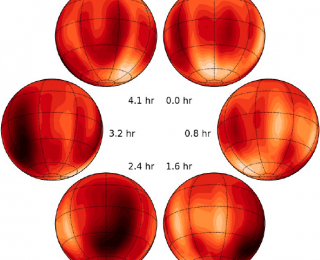
Tune in now for the first extrasolar weather map of a nearby brown dwarf, made using Doppler imaging.
by Erika Nesvold | Feb 14, 2014 | Daily Paper Summaries
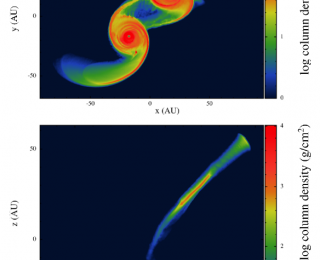
Close encounters with a passing star can excite a planet into an eccentric or inclined orbit. But a circumstellar disk can damp a planet’s eccentricity and inclination. Who wins? Find out when the authors of this paper model a stellar flyby with two circumstellar disks!
by Ruth Angus | Feb 13, 2014 | Daily Paper Summaries
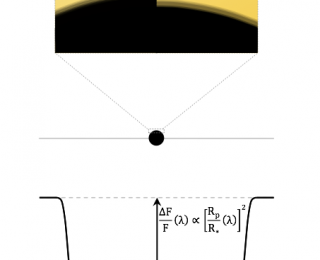
A simple and elegant (but hard) alternative method for measuring exoplanet masses.
