by Erika Nesvold | Nov 15, 2013 | Daily Paper Summaries
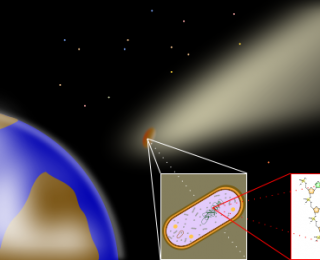
Can life spread from Earth to the moons of Jupiter and Saturn on rock ejected from meteoroid collisions? The authors of this paper start on answering this question by asking if ejected material from Earth can even reach the gas giants’ moons. The answer is yes, so it’s possible that microbial Earthlings have already traveled a lot farther than human ones.
by Ruth Angus | Nov 14, 2013 | Daily Paper Summaries
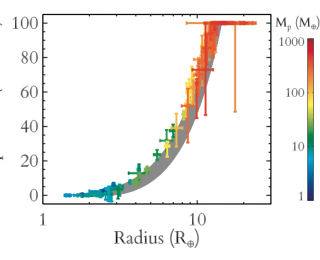
Planetary radius is found to depend strongly on planet composition. The observed planet radius distribution can be recast as a composition distribution, with implications for the way planets form.
by Elisa Chisari | Nov 13, 2013 | Daily Paper Summaries
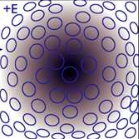
Observing dark worlds is a public competition for improving algorithms to find dark matter halos in weak gravitational lensing maps. Today, we discuss citizen science projects and describe the results of the challenge.
by Meredith Rawls | Nov 12, 2013 | Daily Paper Summaries
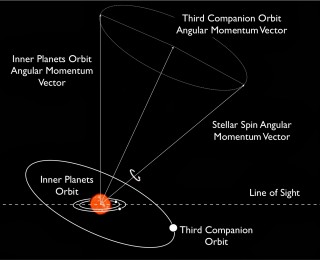
Our Solar System is pretty straightforward. Roughly speaking, all the planets orbit in the same plane, most spin on their axes in the same direction in that plane, and even the Sun rotates in a manner consistent with all this. The small, rocky planets are closer to the Sun, and the big, gaseous planets are farther from the Sun. Simple. Now that we are finding planets orbiting other stars, many are turning out to be multiplanet systems like our own Solar System.

by Justin Vasel | Nov 7, 2013 | Daily Paper Summaries
A neutrino detector sits on the floor of the Mediterranean Sea whose goal it is to identify neutrinos from high-energy astrophysical sources.
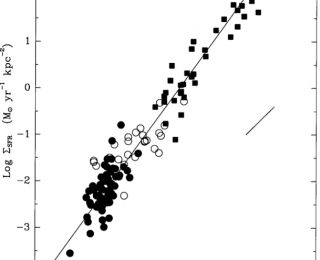
by Chris Faesi | Nov 5, 2013 | Classics, Daily Paper Summaries
In today’s “astrophysical classic”, we delve into the seminal paper behind the Kennicutt-Schmidt relation, the empirical correlation between the star formation rate and gas density.
