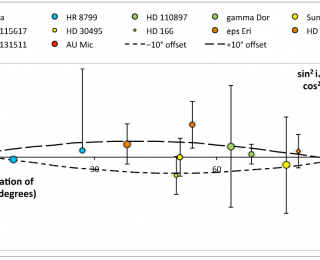
Debris Disks and Stars Spin Together
Herschel observations reveal that debris disks are aligned with their stars’ equators, unlike some close-in transiting exoplanets.

Herschel observations reveal that debris disks are aligned with their stars’ equators, unlike some close-in transiting exoplanets.
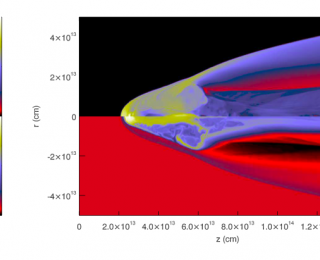
What happens when an astrophysical jet moving at enormous speeds plows into the gas and dust around it? Some of that matter gets dragged along for the ride — and according to this author, this process could create the two different types of jets that we see.
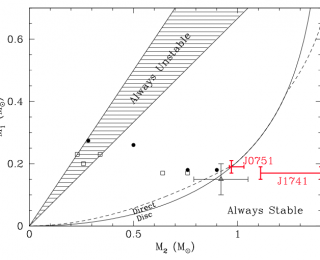
The progenitors of a special type of cataclysmic variable, AM CVn, and possibly supernovae have been found.
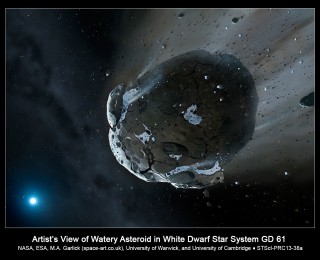
Astronomers have found evidence of water in the remains of a planetary system around a white dwarf. This indicates water-rich asteroids can bring water to terrestrial planets, important for the habitability of planets.
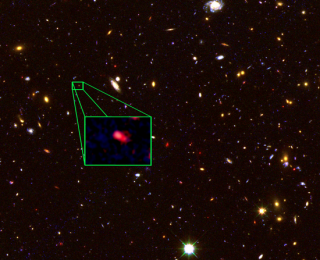
The authors of this work report the discovery of the most distant, spectroscopically-confirmed galaxy found to date, which presently lies about 30 billion light years from Earth. The galaxy is being observed as it was at a time just 700 million years after the Big Bang, which is a mere 5% of the universe’s current age of 13.8 billion years.
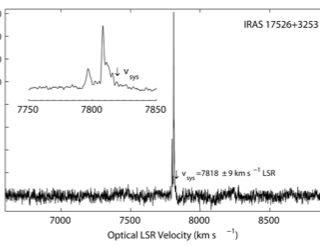
Giant clouds of molecules in space provide the gain material for astrophysical masers, emitting microwave radiation by stimulated emission. These bright sources can be used to determine extragalactic distances and black hole masses. This paper reports on a search for new extragalactic water masers with the Very Long Baseline Array, and reports on the discovery of four sources in 37 objects searched.