by Nathan Sanders | Oct 28, 2013 | Daily Paper Summaries
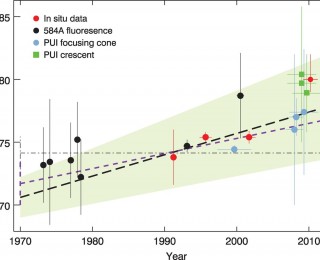
Douglas Adams’ fictional Ford Prefect famously warned us of eddies in the spacetime continuum. Has the IBEX spacecraft now found evidence that they really exist?
by Guest | Oct 24, 2013 | Daily Paper Summaries
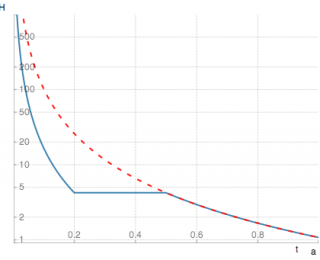
Today’s post is a guest contribution from Dr. Andrew Pontzen, a Royal Society University Research Fellow at University College London and an expert in galaxy formation and cosmology. Andrew is also a leader in the use of fantastic visualizations and interactive graphics as explanatory and teaching tools, and in this post he uses this approach to provide a new look at the cosmological concept of inflation. Loading the post. If this message doesn’t disappear, please check that javascript is enabled in your browser. Cosmic inflation is a hypothetical period in the very early universe designed to solve some weaknesses in the big bang theory. But what actually happens during inflation? According to wikipedia and other respectable sources, the main effect is an ‘extremely rapid’ expansion. That stock description is a bit puzzling; in fact, the more I’ve tried to understand it, the more it seems like inflation is secretly all about slow expansion, not rapid expansion.The secret’s not well-kept: once you know where to look, you can find a note by John Peacock that supports the slow-expansion view, for example. But with the rapid-expansion picture so widely accepted and repeated, it’s fun to explore why slow-expansion seems a better description. Before the end of this post, I’ll try to recruit you to the cause by means of some crafty interactive javascript plots. A tale of two universes There are many measurements which constrain the history of the universe. If, for example, we combine information about how fast the universe is expanding today (from supernovae, for example) with the known density of radiation and matter (largely from the cosmic microwave...
by Sukrit Ranjan | Oct 23, 2013 | Daily Paper Summaries
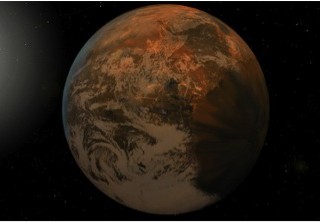
This paper asks what the biosphere of the Earth will look like billions of years from now, when the era of life is ending. What biosignatures might we detect from a dying planet?
by Maria Drout | Oct 21, 2013 | Daily Paper Summaries
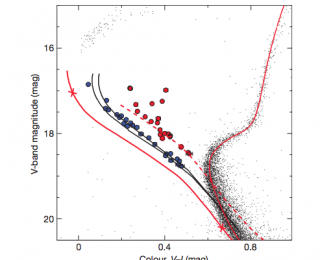
The authors identify two distinct sequences of blue straggler stars in the globular cluster NGC 392. They hypothesize that one branch is formed via stellar mergers and the other is binary stars undergoing mass transfer. This is the second globular cluster found to possess this double sequence.
by Ben Montet | Oct 18, 2013 | Daily Paper Summaries
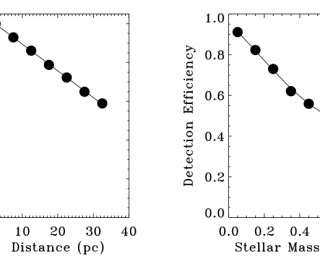
There’s a new space telescope on the block, which just might find as many new planet candidates as the Kepler mission.
by Erika Nesvold | Oct 17, 2013 | Daily Paper Summaries
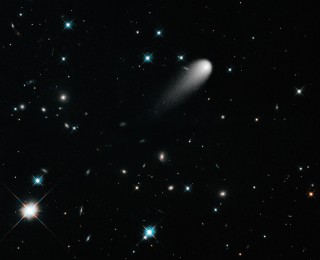
Comet ISON will be flying by on its way from the Oort Cloud to the Sun and back for the next couple months. Will the meteoroids it leaves behind produce any meteor showers here on Earth? The authors of this paper use orbital mechanics to find out.
