
by Guest | May 13, 2026 | Daily Paper Summaries
Tidal disruption events can happen when stars are torn apart by a supermassive black hole at the centre of a galaxy. Guest author, Mary Ogborn, explains how tidal disruption events can help us see when supermassive black holes wander away from their galaxy’s centre.

by Flavia Pascal | May 12, 2026 | Daily Paper Summaries
Whether you are already a fan of Greek mythology or someone who only vaguely remembers Icarus from a long-forgotten school lesson, today’s Astrobite will show you that flying too close to the Sun (and its consequences) is more than a myth when it comes to extremely hot exoplanets.

by Annika Salmi | May 11, 2026 | Daily Paper Summaries
What if the ingredients for life did not bubble up from a pond or vent, but fell from space as dust? A new paper suggests ancient glaciers may have collected this cosmic dust, concentrated it, and helped kick-start prebiotic chemistry.
by Laurie Amen | May 9, 2026 | Daily Paper Summaries, PRJ
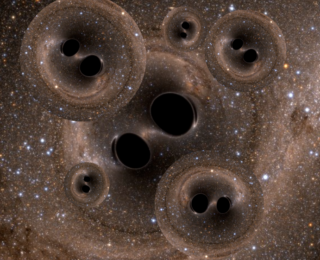
Did you know that many observed black holes theoretically shouldn’t exist? Today’s paper gathers gravitational wave evidence for how these impossible black holes might have formed.
by Flavia Pascal | May 7, 2026 | Daily Paper Summaries
We cannot travel back in time, but we can still try to reconstruct how planets evolved from the clues they leave behind today. In this Astrobite, we explore how L 98-59 d’s atmosphere and interior models reveal a molten world still being reshaped by its host star.
by Akshita Mittal | May 6, 2026 | Daily Paper Summaries
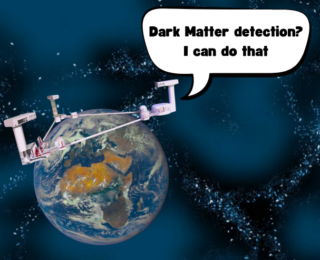
Today we explore how Einstein Telescope might be the instrument to indirectly see (or hear..?) dark matter!
