by Jayde Willingham | Jul 9, 2026 | Daily Paper Summaries
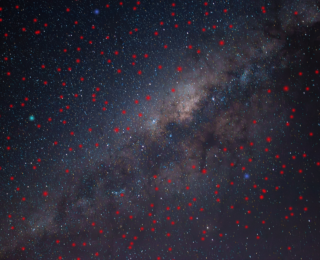
Little Red Dots have been thought to be mysterious early universe objects but today’s bite tells us that they could exist much closer to home.
by Chloe Klare | Jul 1, 2026 | Daily Paper Summaries
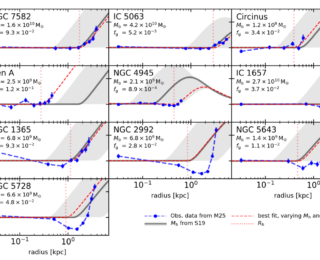
There’s drama in the extragalactic astronomy community today. Some strange accretion-driven outflows in nearby active galaxies have been observed to accelerate in the galactic outskirts. In today’s paper, our authors explain why an earlier proposed theory is likely wrong, present their own theory, and let the observers know what they need to do to settle the debate.
by Guest | Jun 15, 2026 | Daily Paper Summaries
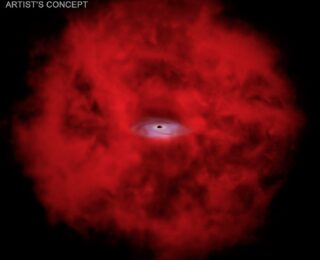
This guest post was written by Aylin Garcia Soto, a graduating Ph.D. student from Dartmouth University studying M dwarf variability. She will start a postdoc at Boise State University working with Dr. Brian Jackson on tidal decay in exostellar systems. Outside of research, she enjoys reading, watching K dramas (and other dramas), playing guitar, and writing creative stories. Title: Exploring the Active Galactic Nucleus Fraction of a Sample of JWST’s Little Red Dots at 4 < z < 8: Overmassive Black Holes Are Strong Flavored Authors: Emmanuel Durodola, Fabio Pacucci, Ryan C. Hickox First Author’s Institution: Department of Physics & Astronomy, Dartmouth College, Hanover, NH 03755, USA Status: Published in ApJ [open access] The Little Red Dot Once upon a time there was an object called Little Red Dot. It lived a long long long (over 12 billion years) ago with a big big big (x10) ol’ black hole wrapped in a large dusty blanket. One day, a gentle-telescope named JWST took its camera to visit its universe, and on its way, it bumped into Little Red. Oh my, what a red, old, compact galaxy you are. All the better to confuse you with, my dear scientist. What strange spectral energy distribution you present. All the better to keep you guessing (what I am). The Little Red Dots and Modern AGNs Much of what we know about Little Red Dots (LRDs) arose after 2024 thanks to data from the JWST space telescope. These red objects represent emitted light from high-redshift or distant objects that formed about 1.5 billion years after the big-bang (13.8 billion years ago). To measure the...
by Margaret Verrico | Feb 10, 2026 | Daily Paper Summaries
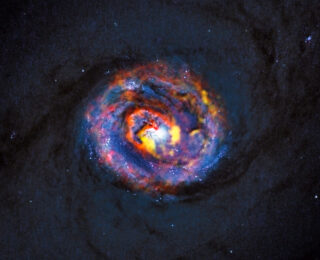
Astronomers think active black holes may play a role in shutting down star formation, but today’s study suggests that the story is more complicated than we thought.
by Margaret Verrico | Dec 18, 2025 | Daily Paper Summaries
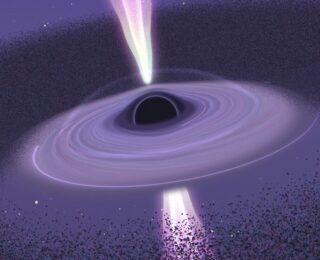
Today’s bite zooms in on nearby galaxies to understand how they impact future stellar nurseries and (maybe) suppress star formation.
by Brandon Pries | Dec 6, 2025 | Daily Paper Summaries, PRJ
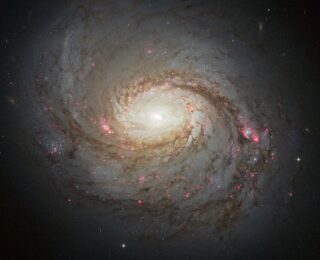
Today’s authors investigate how the physics in the extreme environments in the centers of galaxies leads to connections between X-rays and ghostly particles called neutrinos!
