by Kirit Karkare | Aug 20, 2013 | Daily Paper Summaries
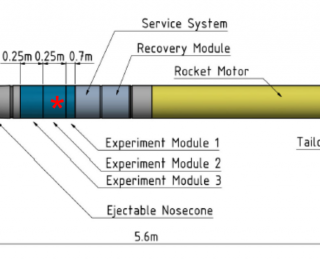
By sending a chamber of dust on a suborbital ballistic rocket, the authors of this paper hope to find out how planetesimals form.

by Nick Ballering | Mar 25, 2013 | Daily Paper Summaries
Spectroscopy with Herschel can probe the dust in the heart of protoplanetary disks through the 69 micron feature of forsterite. Examining these features in detail reveals that the dust grains are small, iron poor, and confined to narrow rings.
by Elisa Chisari | Feb 2, 2013 | Daily Paper Summaries
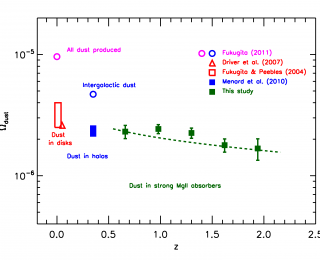
Dust is really ubiquitous in the Universe: it is everywhere from our Solar System to stars and the interstellar medium. However, the observations of dust in galaxies fall short of the prediction of how much dust there is in the Universe. In this work, the authors try to alleviate this problem by estimating the amount of dust present in clouds of gas that inhabit galaxy halos while they look for clues regarding the origin of these clouds.
by Sukrit Ranjan | Nov 14, 2012 | Daily Paper Summaries
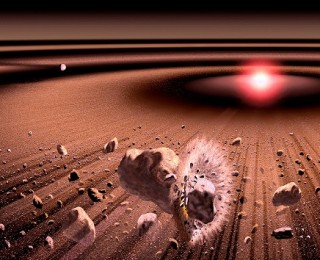
Paper Title: Comet-Like Mineralogy of Olivine Crystals in an Extrasolar Proto-Kuiper Belt (arxiv: 1211.2626) Authors: B. L. de Vries et al First Author’s Affiliation: K. U. Leuven, Flanders, Belgium Journal: Nature OverviewThis paper describes observations of the mineral olivine in the famous debris disk surrounding the star Beta Pictoris. Olivine is very important as it is one of the primary building blocks of rocky planets. They find its composition and temperature to match what we find in our outer solar system, hinting that we are spying on a proto-Kuiper belt. The similarity between solar systems suggests similar processes may be operating in other systems as happened here around Sol.More DetailIn the past decade, we’ve made huge advances in remote characterization of planetary bodies. From the atmospheres of exoplanets to the surfaces of asteroids, astronomers have conducted some pretty extraordinary measurements (for example, the discovery of Alpha Centauri Bb, which entailed measuring the motion of Alpha Cen to 51 cm/s — a slow walk!). However, most of these measurements have been surface measurements. It’s much harder to study the interiors of objects, because we don’t receive photons from them.There are exceptions, though. Consider a young planetary system with plenty of asteroids. These asteroids will run into each other, shattering apart and generating dust. Light passing through these dust clouds will then have their spectral signature imprinted on them, letting us study their interior composition!Astronomers have discovered several such systems, allowing us for the first time to characterize the interior composition of rocky bodies remotely. This paper presents the results of the latest such study, on the system Beta Pictoris. Beta...
by Courtney Dressing | Aug 17, 2012 | Daily Paper Summaries
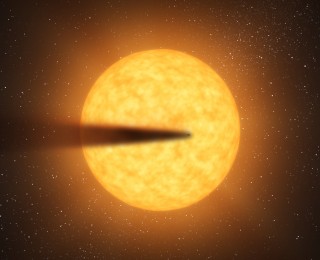
Could the strange transit-light signature seen in the light curve of a Kepler target be caused by a transiting dust cloud?
by Nathan Sanders | Jul 9, 2012 | Daily Paper Summaries
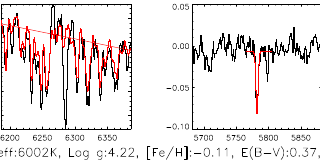
The current and next generation of large scale spectroscopic surveys could provide new clues in the hunt for the carriers producing mysterious interstellar absorption features.
