by Steph Greis | Jan 22, 2016 | Daily Paper Summaries
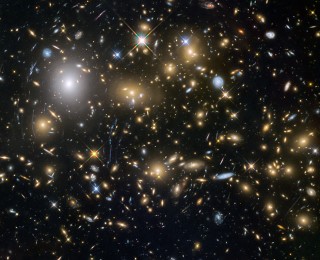
Our current understanding of the Universe suggests that its largest structures, such as clusters and groups of galaxies, would have formed only within the second half of the Universe’s current age. However, today’s paper explores the proposed observational evidence that such structures may actually have began forming a lot earlier than we expected. This poses intriguing questions about the way we model the cosmos, how we interpret our observations, and whether we might need to rethink cosmology.
by Mara Johnson-Groh | Jan 18, 2016 | Daily Paper Summaries
Preliminary results from a new survey looking for ultra-bright galaxies in the early universe.
by Becky Smethurst | Nov 27, 2015 | Daily Paper Summaries
Counting the number of galaxies at a given mass in a region of space gives you the number density – something that can be really easily compared to simulations. But do our observations and theory match up? And how does looking out to higher and higher redshifts help us to better understand our Universe…
by Jesse Feddersen | Sep 16, 2015 | Daily Paper Summaries
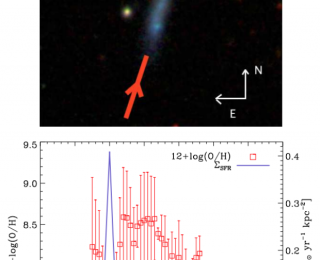
Observations of dwarf galaxies show that sites of active star formation have fewer metals. These galaxies may have been diluted by the impact of pristine gas from the cosmic web.
by Andrew Emerick | Sep 3, 2015 | Daily Paper Summaries
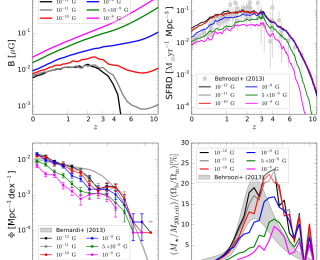
Although magnetic fields exist virtually everywhere, we still do not know quite a lot about the role they play in the evolution of our Universe. On galaxy scales and larger, they can be difficult to observe, but may play a crucial role in how they evolve. Today’s astrobite discusses work done to try and understand how initially weak fields in the early Universe can affect galaxy evolution over time.
by Andrew Emerick | May 19, 2015 | Daily Paper Summaries
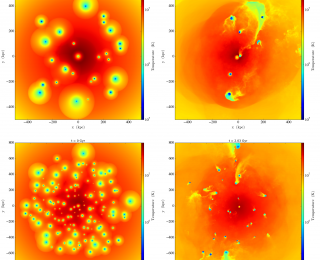
The evolution of a galaxy is strongly dependent upon the environment the galaxy lives in. Galaxies moving through galaxy groups and galaxy clusters can get stripped of their gas that would otherwise be used to form stars. Today’s astrobite discusses simulations of the stripping and removal of the hot, gaseous coronae that surround galaxies.
