by Erika Nesvold | Jan 18, 2014 | Daily Paper Summaries
Title: Superhabitable Worlds Authors: René Heller and John Armstrong First Author’s Institution: McMaster University Status: Published in Astrobiology Note: This journal article covers two topics that we thought each deserved its own astrobite. Yesterday’s astrobite discussed the first half of the paper, about the effects of tidal heating on habitability. Today’s astrobite explores the concept of superhabitability.Introduction to SuperhabitabilityLet’s talk about the Copernican principle. This idea states that we (humans, Earth, the Solar System, etc) are not special. We’re not the center of the universe, and there’s no particular reason to believe that we’re unique in the Universe. We’re just average, middle-of-the-road, ordinary. In a lot of cases this has turned out to be true — Earth is not the center of the Solar System, the Solar System is not the center of the Galaxy, and the Milky Way Galaxy is only one of many. So this concept is really useful when trying to understand cosmology, but what does it mean in the context of our search for habitable worlds? The Copernican principle would imply that the reason life exists on Earth is not because Earth is a unique, magical place. Instead, life exists on Earth because Earth happens to have the right physical conditions to allow life to evolve, and those physical conditions probably exist elsewhere, too. So our search for “habitable” worlds is often conflated with a search for “Earth-like” worlds — planets and moons with the same size, density, and surface temperature as Earth.But what if we’re not average? What if Earth isn’t your standard suburb of habitability, but actually a rough neighborhood, habitable-but-only-barely? In an...
by Erika Nesvold | Jan 17, 2014 | Daily Paper Summaries
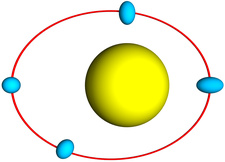
Today’s paper is too awesome to be contained in merely one astrobite, so we’ve split it into two parts. In Part 1, find out how you can keep warm even if you’re far outside your star’s habitable zone (if “you” are a planet or moon, that is). Tune in tomorrow for Part 2: Superhabitability and You!
by Chris Faesi | Dec 31, 2013 | Daily Paper Summaries
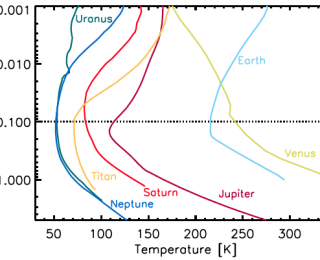
A new model explains the common 0.1 bar temperature minimum in certain types of planetary atmospheres.
by Jessica Donaldson | Oct 30, 2013 | Daily Paper Summaries
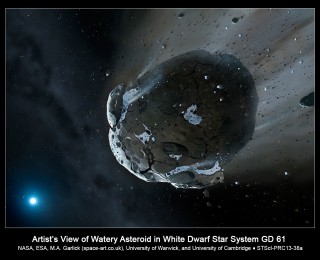
Astronomers have found evidence of water in the remains of a planetary system around a white dwarf. This indicates water-rich asteroids can bring water to terrestrial planets, important for the habitability of planets.
by Sukrit Ranjan | Aug 13, 2013 | Daily Paper Summaries
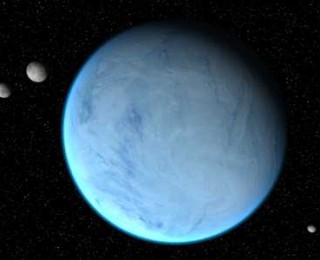
This article uses theoretical modeling to estimate the influence of ice and snow on the habitability of extrasolar planets. This work differentiates itself from past efforts by including the influence of the atmosphere, and by considering planets orbiting M-dwarfs in addition to Sun-like stars.
by Erika Nesvold | Jul 25, 2013 | Daily Paper Summaries
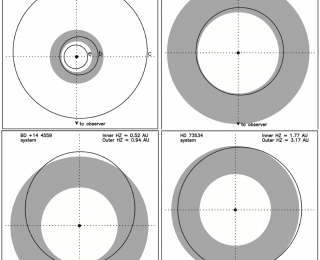
The search for exoplanets in their habitable zones continues. But exomoons could be habitable, too! This paper models hypothetical exomoons in four real systems to determine the habitability of moons around planets that don’t necessarily stay in the habitable zone.
