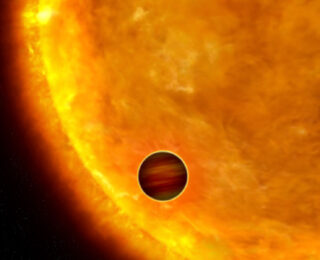
UR: Characterizing the atmosphere of hot Jupiter CoRoT-1 b
In our latest #UndergradResearch post, we learn how Kayli Glidic used eclipse spectra to characterize the atmosphere of a hot Jupiter.

In our latest #UndergradResearch post, we learn how Kayli Glidic used eclipse spectra to characterize the atmosphere of a hot Jupiter.
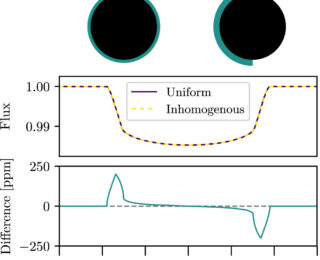
As the field of exoplanet atmospheric science rapidly moves towards understanding these fascinating worlds as complex, three-dimensional entities, today’s paper explores how we can find non-uniform cloud cover on exoplanets using JWST!
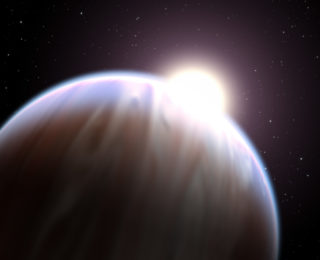
In this paper, the authors discuss a unique system called TOI-1130 which contains both a hot Jupiter and a mini-Neptune.

An international team of astronomers discover an ultra-hot Jupiter where liquid iron literally rains from the skies.
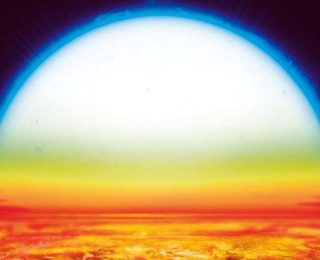
What do the atmospheres of ultra-hot Jupiters and 70s music have in common? A good deal of metal.
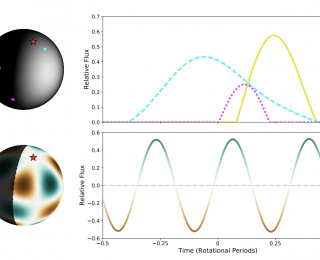
Mapping the atmospheres and surfaces of exoplanets is ailed by degeneracies due to the choice of map structure and orbital parameter uncertainties. Today’s paper attempts to solve this by using a principal component analysis approach.