by Lucia Morganti | Jun 1, 2012 | Daily Paper Summaries
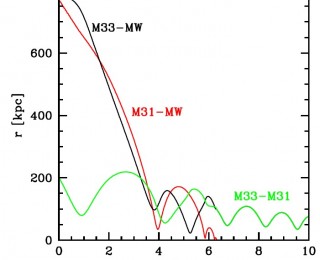
HST measurements of stellar proper motions in M31 reveal that the Andromeda galaxy is in radial (head-on collision) orbit towards the Milky Way. The huge strike will happen 4 billion years from now according to the simulations. It will likely affect also the environment of the Sun and the location of the solar system.

by Adele Plunkett | Apr 27, 2012 | Daily Paper Summaries
This paper suggests a new quantity to measure the brightness of gas emission throughout the Milky Way, and determines the regions where most stars are likely to be forming in our Galaxy.
by Evan Schneider | Mar 20, 2012 | Daily Paper Summaries
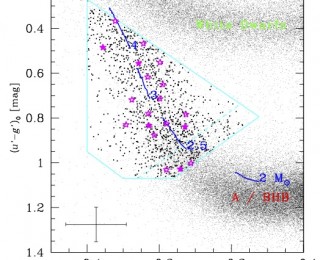
Five new hypervelocity stars have been discovered in the outer regions of the Milky Way. In this paper, the authors discuss what these stars are, how they got so far away, and what their distribution implies about the center of our galaxy.
by Lucia Morganti | Jan 13, 2012 | Daily Paper Summaries
Understanding the structure of our Milky Way is as difficult as trying to see the forest from the trees. Among the many uncertainties, we don’t know whether the molecular ring is really due to a ring structure or it is simply produced by the spiral arms.
by Susanna Kohler | Dec 16, 2011 | Daily Paper Summaries
Remember that tidal disruption event we talked about earlier this year, where a star got just a little too close to a quiescent black hole? Well, here’s our chance to witness something similar, happening in the center of our very own galaxy!
by Nathan Goldbaum | Dec 2, 2011 | Daily Paper Summaries
It is written in The Standard Lore of Astronomy – a leather-bound book professors keep under their desks – that stars in the disks of spiral galaxies have a bimodal distribution of scale heights. Today we will be discussing a paper that comes to the conclusion that the notion of a thick disk and a thin disk is actually a poor approximation to the true distribution of disk stars.
