by Ben Cook | Dec 22, 2014 | Daily Paper Summaries
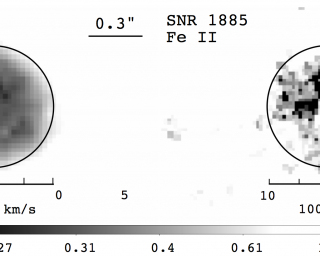
Title: The 2D Distribution of Iron Rich Ejecta in the Remnant of SN 1885 in M31 Authors: Robert A. Fesen, Peter Hoeflich, Andrew J.S. Hamilton First Author’s Institution: Dartmouth College Paper Status: Submitted to The Astrophysical Journal Supernova 1885 In August of 1885, a powerful supernova erupted in our neighboring galaxy, Andromeda. Astronomers name supernovae by the year and order in which they exploded, and since no other supernovae went off in 1885 which were bright enough for us to observe, this event became known simply as SN 1885. No recorded spectra of the supernova exist, but the original observers — viewing the light through spectral filters — reported that no hydrogen lines were observed. Combined with records of its reddish hue, this has allowed the supernova to be retroactively categorized as Type Ia. As a supernova explodes, much of the star’s original mass is rapidly fused into heavy elements. This debris is ejected rapidly into the interstellar medium (ISM). The supernova’s material will be hotter, denser, and contain more heavy elements than the surrounding matter — thus, it forms a distinct structure known as a supernova remnant. Eventually, the blastwave will expand and sweep up so much of the surrounding gas that it slows itself down, like a projectile under air resistance. Yet the ISM is of such low density that it can take decades to centuries before this deceleration begins. The initial structure of the explosion should therefore be imprinted on the remnant throughout this first phase — known as free expansion — before the ISM mass begins to decelerate the expansion. SN 1885 is though to still...
by Caroline Huang | Dec 15, 2014 | Daily Paper Summaries
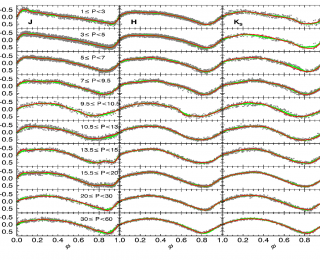
Distance is a tricky thing to measure in astronomy. We can’t use tape measures or rulers, and even more sophisticated methods like laser ranging are only good for the very nearest of neighbors, like the moon. That’s where distance indicators like Cepheids come in.
by Michael Zevin | Dec 10, 2014 | Daily Paper Summaries
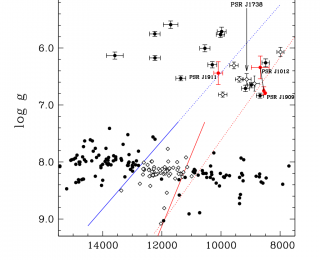
The recent discovery of two pulsating, compact stellar remnants intertwined in a binary system has uncovered a system never-before observed in our Universe, and will offer new avenues for studying the exotic objects involved.
by Jesse Feddersen | Dec 8, 2014 | Daily Paper Summaries
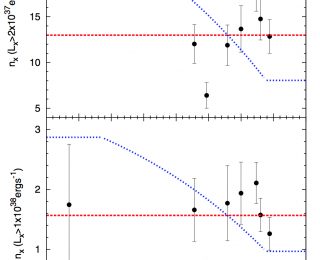
Sometimes stellar remnants cannibalize other stars, emitting x-rays that can be detected in distant galaxies. Learn how making a careful tally of these gruesome events can reveal how stars are formed.
by Caroline Huang | Nov 17, 2014 | Daily Paper Summaries
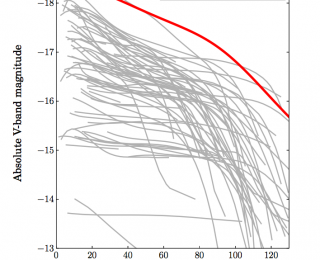
There are arguably a lot of things defy categorization, but it’s not everyday that we find something that suggests we do away with our categories altogether. The authors of today’s paper believe that the recently-discovered Type II supernova ASASSN-13co — read that as “assassin”, please — might just be one of the latter.
by Anson Lam | Nov 3, 2014 | Daily Paper Summaries
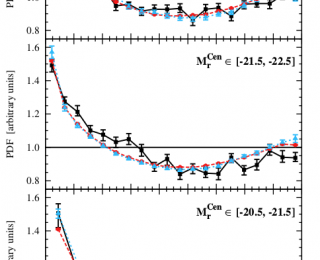
Satellite galaxies orbiting a host galaxy seem to display highly anisotropic angular distributions.
