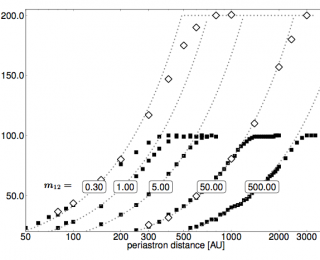
Mugged by a Passing Star
A close encounter with another star can disrupt the protoplanetary disk of a young star, leaving a smaller disk behind. Can we learn anything about the encounter from the size of the remaining disk? Read on to find out!

A close encounter with another star can disrupt the protoplanetary disk of a young star, leaving a smaller disk behind. Can we learn anything about the encounter from the size of the remaining disk? Read on to find out!
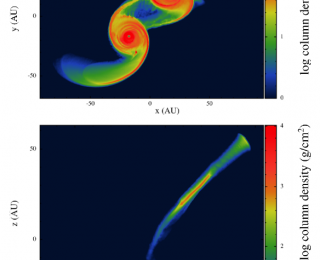
Close encounters with a passing star can excite a planet into an eccentric or inclined orbit. But a circumstellar disk can damp a planet’s eccentricity and inclination. Who wins? Find out when the authors of this paper model a stellar flyby with two circumstellar disks!
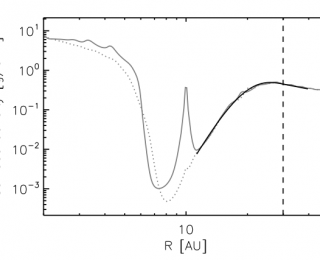
The mass of a substellar companion can help determine whether it’s a planet or a brown dwarf. But how can you measure the mass of a companion that you can’t detect directly? Look at the disk!
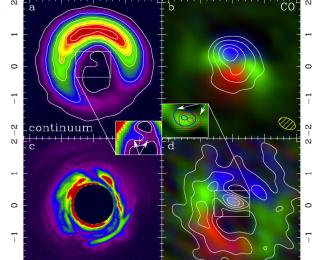
There’s a lot going on in the HD 142527 protoplanetary disk — accretion, gap opening, and a horseshoe-shaped dust ring. The authors of this paper used ALMA to take a closer look at the gas and dust in this busy disk.
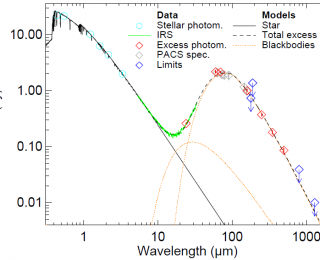
The disk around 49 Ceti is known to show characteristics of both protoplanetary and debris disks. New observations with Herschel reveal that it is likely a debris disk with gas generated by evaporating comets.
Spectroscopy with Herschel can probe the dust in the heart of protoplanetary disks through the 69 micron feature of forsterite. Examining these features in detail reveals that the dust grains are small, iron poor, and confined to narrow rings.