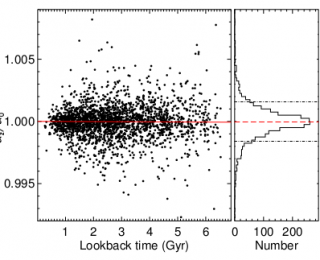
Constraining fine-structure constant variations using QSOs
From measurements of quasar spectra, we can determine whether or not the fine structure constant is really a constant.

From measurements of quasar spectra, we can determine whether or not the fine structure constant is really a constant.
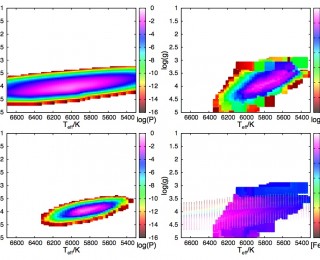
The link between a pile of data and a physical explanation is the fun part. Astronomers spend countless hours gathering data, and countless more thinking up physical models for different pieces of the Universe. But reconciling these two things—finding a model that not only agrees with observations, but is the sole likely explanation—isn’t easy.

Astronomers have found evidence of water in the remains of a planetary system around a white dwarf. This indicates water-rich asteroids can bring water to terrestrial planets, important for the habitability of planets.
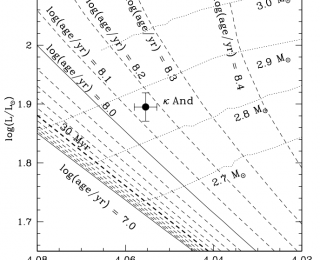
A “Super-Jupiter” recently discovered by direct imaging techniques may not be as it initially seemed. Hinkley et al. find the system to be older than expected and the Super-Jupiter to really be a brown dwarf.
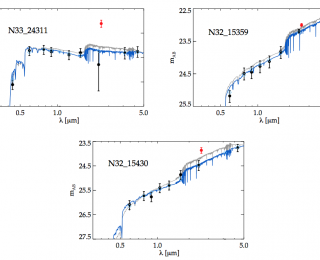
How do emission lines from nebulae affect broad-band photometry of high redshift galaxies?
How can we find the distant galaxies that were responsible for bringing us out of the cosmic dark ages?