
by Nick Ballering | Mar 25, 2013 | Daily Paper Summaries
Spectroscopy with Herschel can probe the dust in the heart of protoplanetary disks through the 69 micron feature of forsterite. Examining these features in detail reveals that the dust grains are small, iron poor, and confined to narrow rings.
by Josh Fuchs | Mar 21, 2013 | Daily Paper Summaries
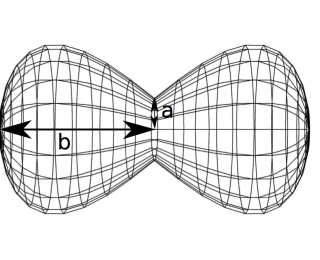
Novae are thermonuclear explosions that occur on the surface of a white dwarf following the accretion of matter from a nearby companion star. The authors seek to understand the geometry and velocity of the ejected material.
by Erika Nesvold | Mar 7, 2013 | Daily Paper Summaries
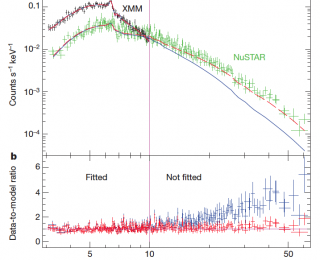
Previous authors have claimed that the black hole at the center of NGC 1365 is spinning extremely rapidly. But these claims are based on certain assumptions about the dominance of relativistic effects on the spectrum of NGC 1365. Risaliti et al., dig deeper into the spectral data of this X-ray source and use simulations to determine whether the signatures we see are caused by a rapidly-spinning black hole, or just cloudy (galactic) weather.
by Betsy Mills | Jan 23, 2013 | Daily Paper Summaries
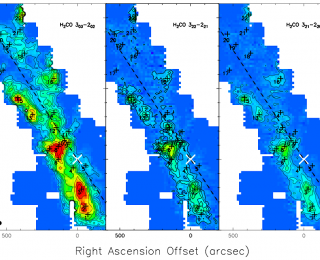
Unlike its candy bar namesake, the center of our Milky Way Galaxy is not actually a very pleasant place to be. There’s a supermassive central black hole to deal with, intense radiation from a population of massive stars, and hot clouds of molecular gas. In this paper, the authors use observations of three molecular spectral lines to measure the temperatures of these gas clouds in the center of the Galaxy, and find that the processes heating the clouds may not be what you expect!
by Betsy Mills | Jan 1, 2013 | Daily Paper Summaries
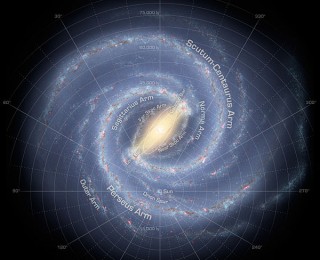
Everything in our galaxy is moving– you, the earth underneath you, the sun, other stars– everything. However, it turns out that figuring out how fast some of these things are moving is surprisingly difficult, and can have Galactic-sized implications!
by Courtney Dressing | Dec 20, 2012 | Daily Paper Summaries
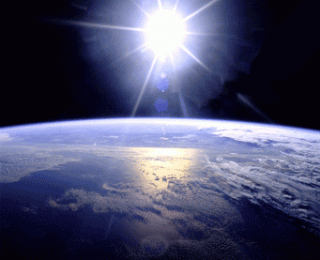
How would the spectrum of the Earth change if our planet orbited a hotter or cooler star? Would alien astronomers still be able to detect signs of life?
