by Elisabeth Newton | Apr 9, 2011 | Daily Paper Summaries
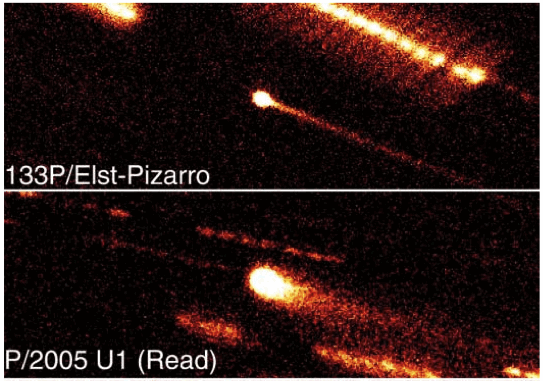
In 2006 Hsieh & Jewitt published the discovery of several main belt asteroids observed to have tails (just like comets do), which activate when nearest the Sun (just like comets do). In this paper, Licandro et al. test the origins of two so-called “main belt comets” by looking at spectra.
by Ian Czekala | Apr 7, 2011 | Quick Notes
We’ve just added a new glossary on Spectroscopy and Spectral Lines. This page, a continual work in progress, will give an overview of how spectroscopy works and what spectral lines are frequently observed by astronomers.
by Dan Gifford | Apr 5, 2011 | Daily Paper Summaries
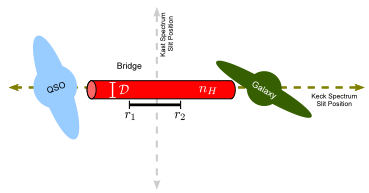
Mergers play an important role in any galaxy’s evolution. A coincidental observation of a quasar and companion galaxy linked by a photoionized gas bridge offers an exclusive look at the merger process at moderate redshift.
by Courtney Dressing | Mar 30, 2011 | Daily Paper Summaries
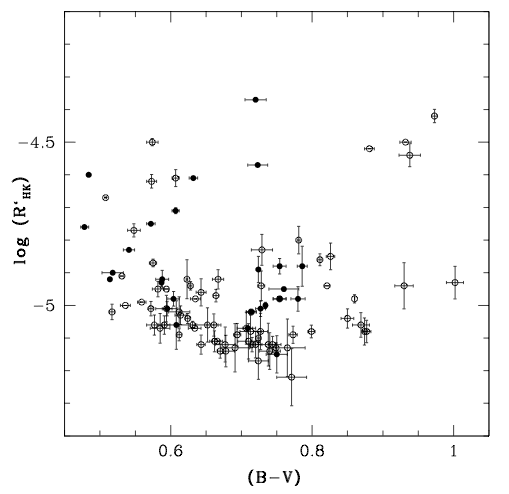
Do close-in planets cause their host stars to become more magnetically active? Canto Martins et al. compare stars with and without planets to address this question.
by Ian Czekala | Mar 27, 2011 | Daily Paper Summaries
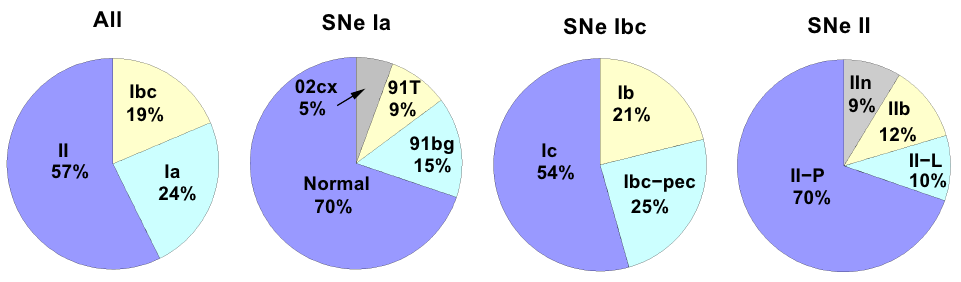
Supernovae, the extremely luminous explosions that are the catastrophic deaths of stars, are used directly and indirectly by astronomers of many disciplines. Cosmologists use type Ia supernovae as powerful “standard candles” to probe the farthest rungs of the cosmic distance ladder. Astrochemists studying the interstellar medium (ISM) track supernovae feedback of heavier elements that enrich the ISM. Astrophysicists working on star formation look for evidence of supernovae-induced collapse of molecular clouds. If supernovae are such ubiquitous tools, then it must be essential to understand the actual supernova (SN) mechanism itself.
by Katherine Rosenfeld | Mar 4, 2011 | Daily Paper Summaries
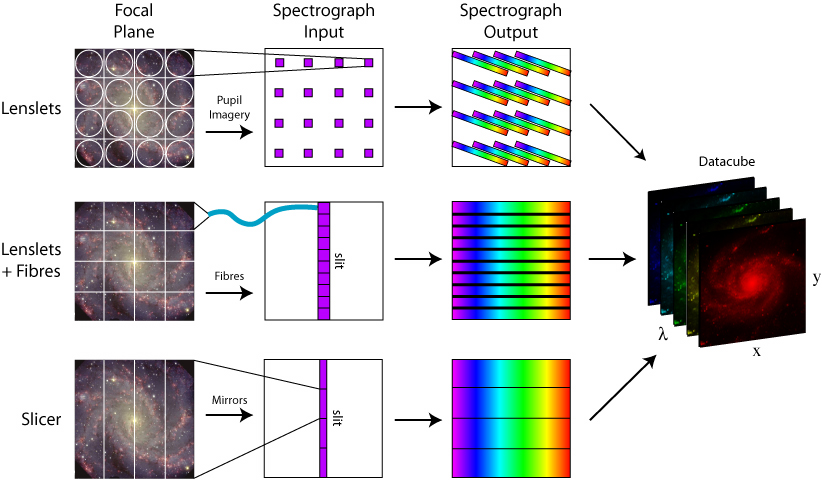
While theoreticians might work in many dimensions, observationalists must often do their analysis using very few. This paper presents observations of a classical nova from two types of spectrographs that determine a distance to the nova and a map of its morphology.
