by Michael Küffmeier | Jun 23, 2015 | Daily Paper Summaries
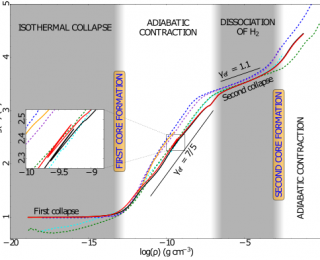
The process of star formation is exciting. During the early phases, a protostar undergoes two characteristic collapses. Today’s Astrobite explains the two collapse phases and briefly discusses their effects on the “final” product: the second core.
by Stacy Kim | Jun 4, 2015 | Daily Paper Summaries
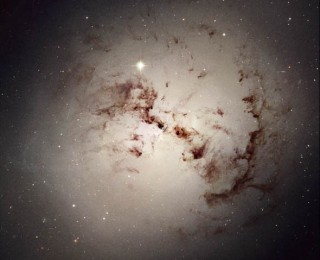
Galaxies die—at least when measured by how vigorously they produce stars. What causes them to die?
by Jesse Feddersen | Jun 1, 2015 | Daily Paper Summaries
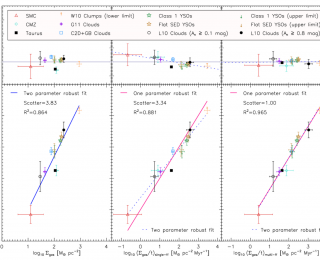
Molecular clouds are turbulent. Today’s paper explores how this fact affects the relationship between star formation rate and density from local clouds to distant galaxies.
by Michael Küffmeier | May 26, 2015 | Daily Paper Summaries
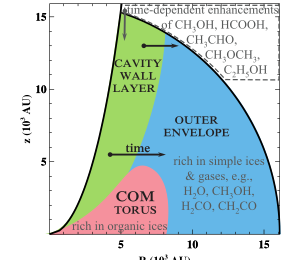
Advanced observational tools such as ALMA allow the detection of complex organic molecules – the building blocks of life. However, how and where they are formed is still unknown.
by Tim Lichtenberg | May 1, 2015 | Daily Paper Summaries
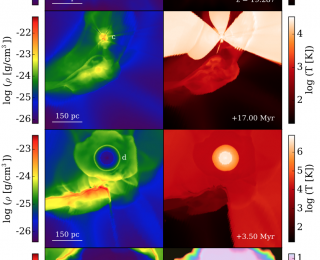
Stars formed in the early Universe were extremely massive and extremely low in elements heavier than helium. The transition from the first to the second generation of stars is still hidden in the shadows of the past. However, simulations of the most massive supernovae can help us to decipher the way of how the life cycle of stars came into being.
by Tim Lichtenberg | Apr 28, 2015 | Daily Paper Summaries
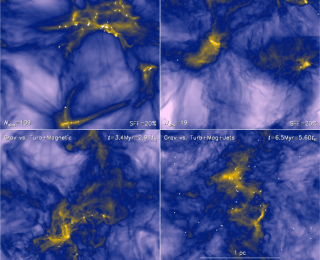
Stars form via gravitational collapse of molecular cloud cores. But observations reveal that far less gas is turned into stars than you would suspect by naively calculating the star formation rate. So what can we do about this mismatch?
