To boldly go where no star has gone before
More than 100 massive stars orbit the supermassive black hole at the center of our galaxy incredibly closely.

More than 100 massive stars orbit the supermassive black hole at the center of our galaxy incredibly closely.
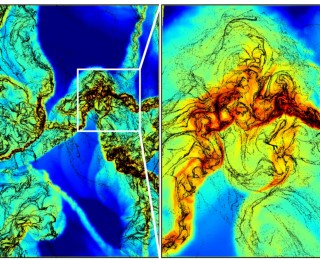
Molecular clouds, where new stars are born, are made of two components: gas and dust. The gas is mostly hydrogen, and the dust is made of elements crucial for forming planets and people, like silicon and carbon. Today’s paper shows that these two components behave very differently in a simulated molecular cloud. This could have exciting consequences for the growth of dust and the formation of stars and planets.
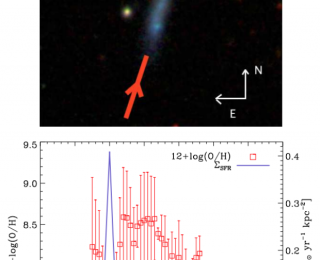
Observations of dwarf galaxies show that sites of active star formation have fewer metals. These galaxies may have been diluted by the impact of pristine gas from the cosmic web.
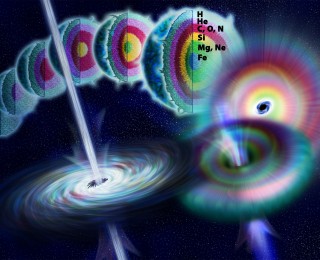
Astronomers have known for a while that GRBs are sign-posts to galaxies which are forming lots of stars. But today’s paper used radio observations of the gas to connect that star formation to a recent merger.
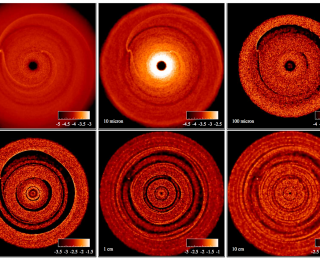
Last year, an image was released that took our breath away. Exquisite rings carved in a disk of material around a nearby star. Now, astronomers want to know if forming planets are responsible, and why the image might look different from the cartoon in your textbook.
Low-mass stars are much more common than massive ones. But massive stars outshine the smaller ones a thousand to one! How can astronomers account for this hidden majority? Maybe alcohol will help…