by Andrew Emerick | Apr 14, 2014 | Daily Paper Summaries
Orbiting our galaxy are many smaller dwarf galaxies. As they orbit, some of these galaxies produce vast streams of gas that stretch around our Milky Way galaxy. Much of this gas still has the potential for forming stars. This astrobite will summarize a recent discovery of one of these stars.
by Ryan Foltz | Apr 5, 2014 | Daily Paper Summaries
The authors use a cosmological simulation to characterize the rates at which galaxies form new stars.
by Ben Montet | Feb 10, 2014 | Daily Paper Summaries
Most binary stars probably formed at the same time, meaning all stars in the same system should have the same age. The authors of this paper analyze a stellar binary system where one star appears to be lying about its age, as one star appears 3 billion years older than its companion.
by Chris Faesi | Nov 5, 2013 | Classics, Daily Paper Summaries
In today’s “astrophysical classic”, we delve into the seminal paper behind the Kennicutt-Schmidt relation, the empirical correlation between the star formation rate and gas density.
by Astrobites | Nov 1, 2013 | Undergraduate Research
The undergrad research posts continue! This month’s post discusses the movement of stars over time, and the influence of galactic bars in triggering star formation.
by Nick Hand | Oct 29, 2013 | Daily Paper Summaries
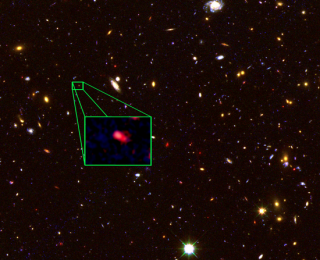
The authors of this work report the discovery of the most distant, spectroscopically-confirmed galaxy found to date, which presently lies about 30 billion light years from Earth. The galaxy is being observed as it was at a time just 700 million years after the Big Bang, which is a mere 5% of the universe’s current age of 13.8 billion years.
