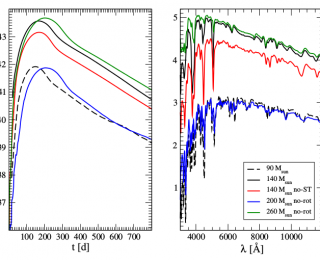
Spinning pair-instability supernovae
How does a massive star’s rotation affect the properties of its eventual explosion?

How does a massive star’s rotation affect the properties of its eventual explosion?
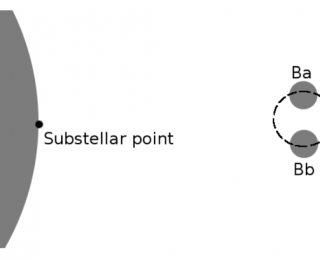
Stars: steady-burning nuclear flames that pierce the darkness of space. Except when they’re not. The star known as HD 181068 is bright, but it’s no standard candle. On closer inspection, this well-studied system is actually home to three stars locked in a complex cosmic dance.
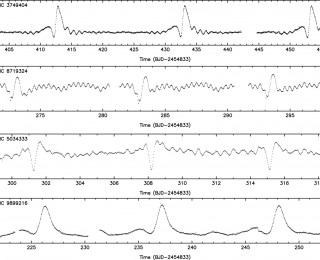
Instead of happily orbiting in circles with constant velocity, the two stars spend most of their time far apart, and a few harrowing hours racing past each other. Or, to put it another way: hours and hours of boredom punctuated by moments of sheer terror. This is a heartbeat star.
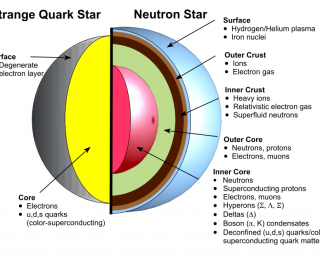
Neutron stars can provide insights into extreme and exotic states of matter.
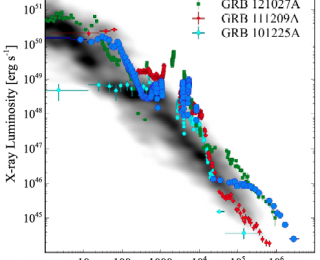
The longest-lasting, most energetic explosions in the universe might occur in rare stars very similar to the very first stars to form in the universe.
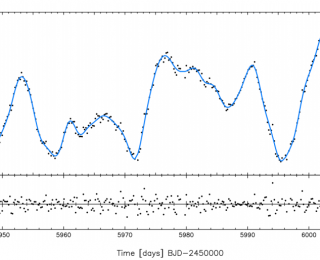
Is CoRoT-7d real, or is it stellar activity masquerading as a planet? Haywood et al. build a noise model to analyze CoRoT-7’s activity to find out.