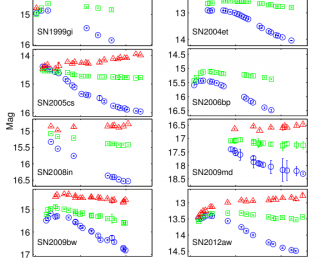
Supernovae Photospheres as Distance Indicators
By examining their expansion rate over time, Type II supernovae provide a way to measure extragalactic distances.

By examining their expansion rate over time, Type II supernovae provide a way to measure extragalactic distances.

There might be more information in the Hubble diagram of supernovae than we first thought. Far away supernovae are subject to gravitational lensing and in the upcoming decades, they could be used to determine how much matter there is in the Universe and how it clusters.
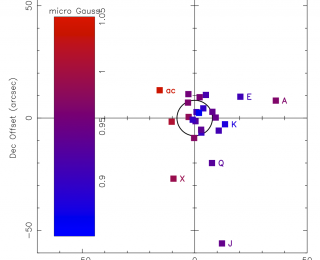
This month’s undergraduate research post features pulsars as a probe of our galaxy’s magnetic field, and the possibility of asymmetries in supernovae associated with gamma-ray bursts.
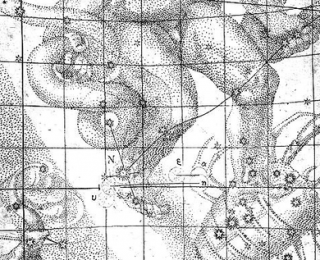
Supernovae happen in the Milky Way at a rate of two or three per century. But, will we be able to see it when it happens next, or will dusty galactic center prevent us from studying it?
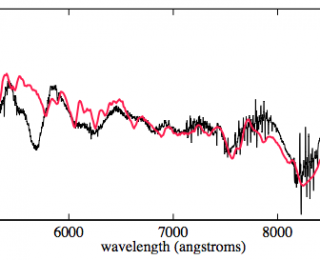
In this paper the authors present simulations of a model to explain rapidly-fading supernovae, a class of transients whose lightcurves decline quickly without substantial radioactive tails. They posits a standard core-collapse explosion of a standard Type Ib/Ic supernova progenitor, but one that produces very little radioactivity and instead exhibits a light curve governed by oxygen recombination.
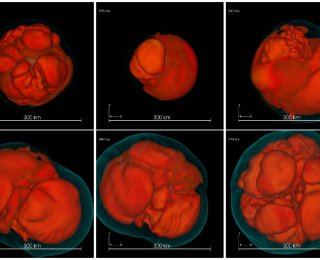
Recent computer simulations are shedding light on the brightest and most energetic phenomena in the Universe – supernova explosions. A team of researchers at the Max Planck Institute for Astrophysics modeled the formation of neutron stars in three dimensions with unprecedented accuracy, showing that as matter is drawn inward, it sloshes both asymmetrically and in spiral motions. It’s a bold, new look into the center of the supernova explosion and the birth of a neutron star.