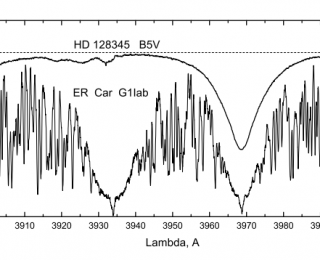
by Caroline Huang | Apr 13, 2015 | Daily Paper Summaries
Cepheids are bright enough that we can use them to measure distances to other galaxies, but their luminosities also makes detecting their companions particularly difficult. So how do astronomers find their uncover their secret partners? Today’s paper takes a look…
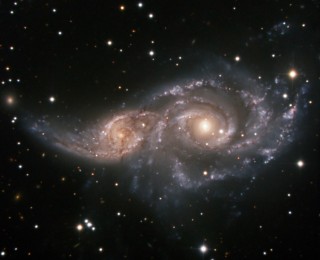
by Suk Sien Tie | Apr 9, 2015 | Daily Paper Summaries
How are supermassive black holes created in the first place? Oh, we need supermassive stars of course! But then, how do we form these supermassive stars…? The answer could be by ramming two protogalaxies against one another at high speeds.
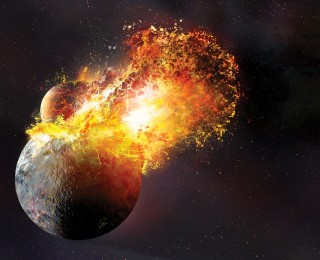
by Michael Zevin | Apr 8, 2015 | Daily Paper Summaries
4.5 billion years ago, a Mars-sized body was believed to have impacted a young Earth, and this planetesimal’s obliterated remains coalesced into what is now our Moon. However, certain striking similarities between the Earth and Moon question the likelihood of this event. Two recent papers investigated the giant impact scenario, only to come to opposite conclusions. Read on to hear more about this lunar enigma.
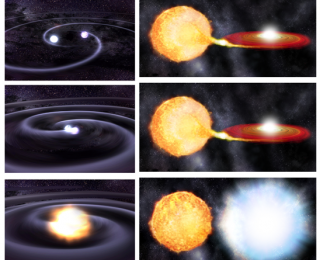
by Ashley Villar | Apr 7, 2015 | Daily Paper Summaries
Type Ia supernovae might be arise from single- or double-degenerate progenitor binaries. Today’s papers suggests that single-degenerate progenitors might account for the extremely bright type Ia supernovae.
by Jesse Feddersen | Apr 6, 2015 | Daily Paper Summaries
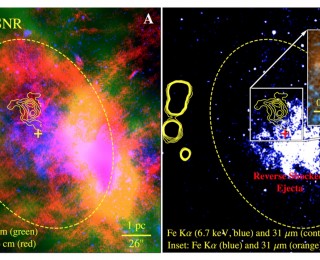
Observations of dust near the remains of a supernova in the center of our galaxy could have implications for dust production in the earliest galaxies.

by Michael Küffmeier | Apr 3, 2015 | Classics, Daily Paper Summaries
Planets seem to occur all over the place in the universe. However, it is still unknown how they form. The growth of objects larger than meter size is difficult because objects of this size quickly fall into the central star. This Astrobite gives a small overview of the meter-size barrier as found by Stuart J. Weidenschilling in 1977.
