by Ben Cook | Nov 24, 2014 | Daily Paper Summaries
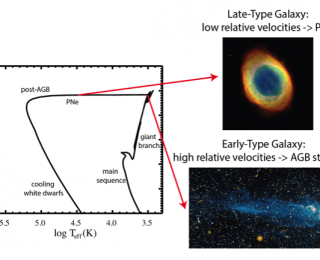
The authors of this paper pursued a mechanism which could possibly keep dead galaxies from forming new stars: mass ejected from AGB stars moving through the galaxy could heat the ambient gas.
by Suk Sien Tie | Nov 21, 2014 | Daily Paper Summaries
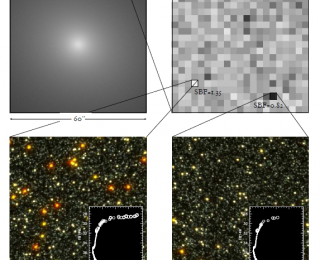
Astronomers use models to derive properties of individual stars that we cannot directly observe, such as mass, age, and radius. This is also the case for a group of stars (a galaxy or a star cluster). One problem with current stellar population models is that they remain untested for old populations of stars. The authors of this paper devise a new way to test models of old stellar populations.
by Meredith Rawls | Nov 20, 2014 | Daily Paper Summaries
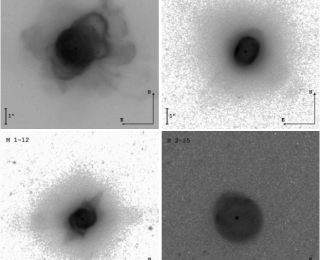
Sometimes, stellar evolution happens on more human timescales—tens to hundreds of years rather than millions or billions.
by Natasha Batalha | Nov 19, 2014 | Daily Paper Summaries
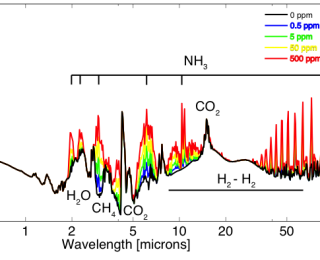
We have one canonical idea of what life looks like on Earth: nitrogen, water, carbon dioxide. But would this be true on another world? When looking for life in the atmospheres of exoplanets, we might want to consider searching for something completely different.
by Caroline Huang | Nov 17, 2014 | Daily Paper Summaries
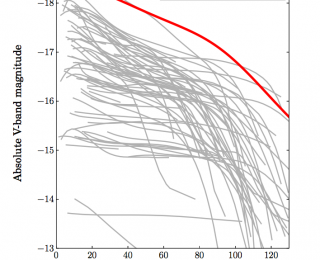
There are arguably a lot of things defy categorization, but it’s not everyday that we find something that suggests we do away with our categories altogether. The authors of today’s paper believe that the recently-discovered Type II supernova ASASSN-13co — read that as “assassin”, please — might just be one of the latter.
by David Wilson | Nov 17, 2014 | Daily Paper Summaries
Over the past decade the study of planetary debris at white dwarfs has become an increasingly exciting area. Observations of this debris have allowed us to make unique discoveries about the chemical composition of extrasolar rocky planets, as well as revealing the endpoints of the evolution of planetary systems very similar to our own…
