by Elisa Chisari | Jun 26, 2013 | Daily Paper Summaries
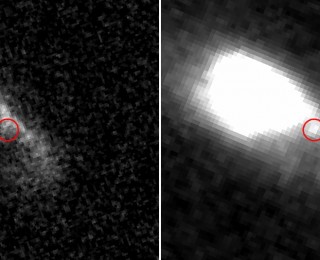
Short gamma-ray bursts, extremely energetic explosions in the Universe, might be caused by the merger of two compact objects. In the two papers we discuss today, the authors test this scenario by looking for light emitted still a few days after the explosion.
by Joseph O'Rourke | Jun 25, 2013 | Daily Paper Summaries
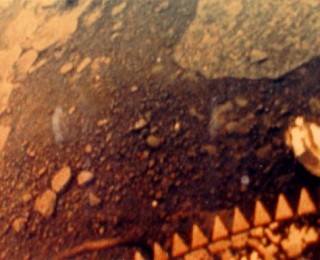
This paper considers the possibility that Earth could suffer a runaway or moist greenhouse effect, which probably turned Venus into a hellish wasteland long ago.
by Kirit Karkare | Jun 24, 2013 | Daily Paper Summaries
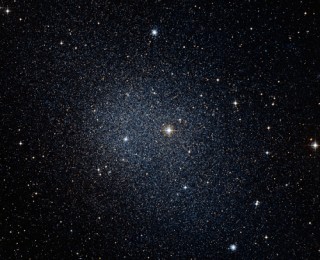
Dark matter particles annihilating could potentially create electrons and positrons, generating continuum synchrotron emission. This paper attempts to find this signature in nearby dwarf galaxies.
by Ryan Foltz | Jun 22, 2013 | Daily Paper Summaries
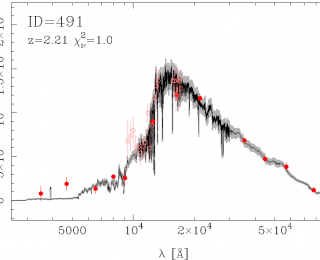
A galaxy cluster in the act of forming reveals some interesting details about the lives of galaxies.
by Nick Hand | Jun 20, 2013 | Daily Paper Summaries
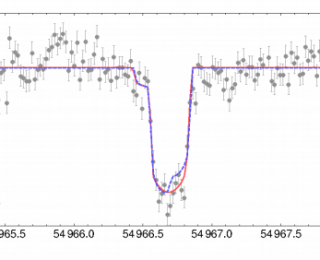
The Hunt for Exomoons with Kepler project has conducted the first ever search for a moon around a planet in the habitable zone. While they find no evidence for such a moon, they demonstrate that Earth-sized and possibly habitable moons should be easily detectable with the current Kepler data.
by Lauren Weiss | Jun 19, 2013 | Daily Paper Summaries
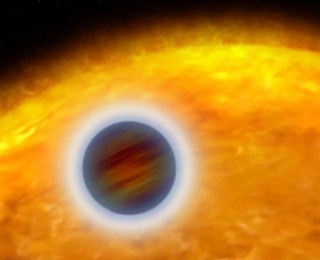
One of the major questions among astronomers who study planets around other stars is, “What kinds of atmospheres do exoplanets have?” This question is extremely challenging to answer empirically: not only are most exoplanets too faint and close to their stars for us to see directly (see this post for an exception), but their atmospheres (especially on small, potentially rocky planets) are only a tiny fraction of the planet’s total composition.
