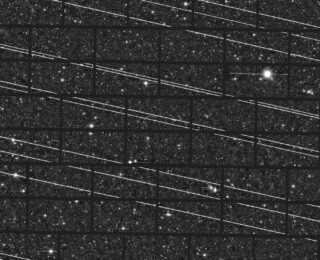
Satellite constellations will harm Rubin LSST science. What can we do?
Astronomers (and one SpaceX engineer) met at a three-day workshop to figure out how to prevent satellites from obstructing LSST science.

Astronomers (and one SpaceX engineer) met at a three-day workshop to figure out how to prevent satellites from obstructing LSST science.
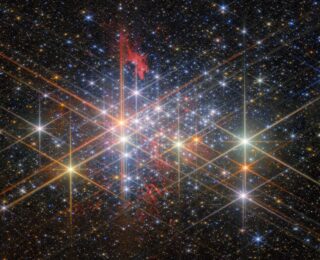
Keeping track of millions of stars is tricky. Today’s authors take on the challenge of accounting for each one’s time of birth.
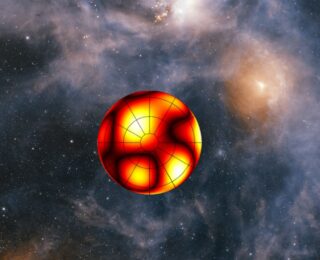
What does the surface of a red supergiant star look like? It’s no polarising statement to say that it has more in common with a pot of bubbling soup than you might think!
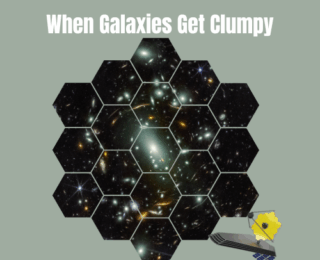
You think stars form quietly? Think again. In the early universe, galaxies were packed with star-forming clumps. Some disrupted quickly, while others survived. Today’s paper reveals which lived and which died young.
For today’s bite, we chatted with Nathan Sanders (one of the original founders of Astrobites) about his journey into and beyond astronomy and the process of writing and publishing a book!
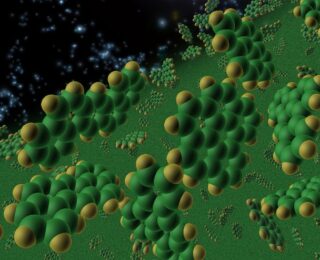
Polycyclic aromatic hydrocarbons (PAHs) are small molecules consisting of rings of carbons, ubiquitous in the interstellar medium. However, PAHs do not seem to be present in protoplanetary disks around the youngest stars. Today’s paper tries to understand why that is.