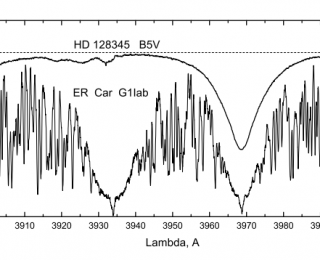
by Caroline Huang | Apr 13, 2015 | Daily Paper Summaries
Cepheids are bright enough that we can use them to measure distances to other galaxies, but their luminosities also makes detecting their companions particularly difficult. So how do astronomers find their uncover their secret partners? Today’s paper takes a look…
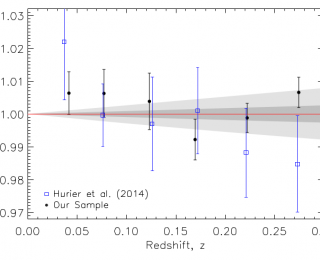
by Anson Lam | Mar 3, 2015 | Daily Paper Summaries
How can we measure the temperature of the Universe across cosmic epochs? Recent data from Planck suggests that the Universe’s cooling history is consistent with the Big Bang model.
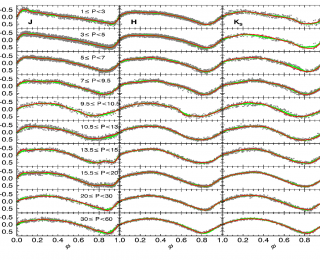
by Caroline Huang | Dec 15, 2014 | Daily Paper Summaries
Distance is a tricky thing to measure in astronomy. We can’t use tape measures or rulers, and even more sophisticated methods like laser ranging are only good for the very nearest of neighbors, like the moon. That’s where distance indicators like Cepheids come in.
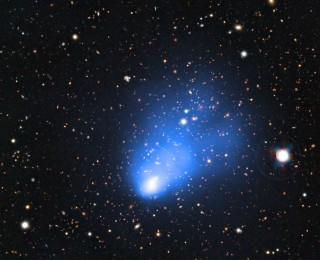
by Stacy Kim | Dec 12, 2014 | Daily Paper Summaries
The El Gordo (in Spanish, “the fat one”), one of the most massive galaxy clusters observed, is an active merger of two large subclusters. Unraveling its dynamics provides insights into $latex \Lambda$CDM.
by Elisa Chisari | Dec 11, 2014 | Daily Paper Summaries
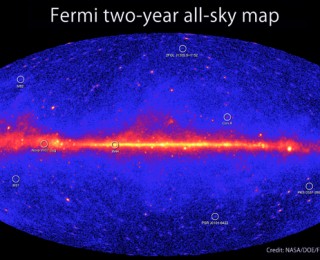
When two observations share some common information, they can be “cross-correlated” to extract it. In today’s example, we discover what the matter halos and energetic phenomena in the Universe have in common through a cross-correlation.
by Brett Deaton | Oct 1, 2014 | Daily Paper Summaries
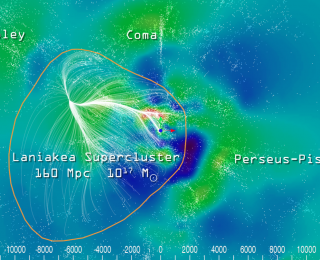
Our local “basin of attraction” is the region containing all the galaxies that would contract to a single point, if we were to neglect the dominant expansion. The authors define this region as our home supercluster, Laniakea.
