
by Leonardo dos Santos | Jan 25, 2016 | Daily Paper Summaries
How can we find other pale blue dots? Today’s paper studies what could be the most time-effective way to search for Earth-like exoplanets, just by looking at their colors.
by Ruth Angus | Dec 4, 2014 | Daily Paper Summaries
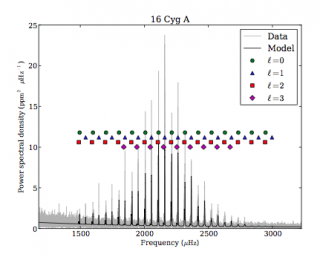
If you didn’t know already, asteroseismology is awesome. Read on to hear why…
by Astrobites | Aug 23, 2014 | Undergraduate Research
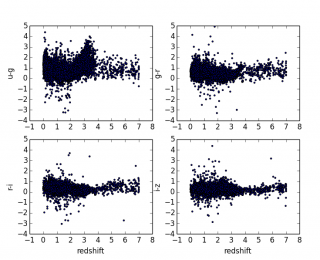
How can the colors of objects tell you how far away they are? The subject of this month’s undergrad research post tells us about his work determining the colors of quasars.
by Joseph O'Rourke | Jun 26, 2014 | Daily Paper Summaries
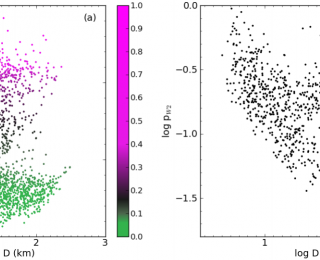
Obtaining high-resolution spectra of asteroids is challenging. Measuring asteroid albedos in broad photometric wavebands is relatively easy, and potentially provides useful information about surface composition.
by Sukrit Ranjan | May 8, 2013 | Daily Paper Summaries
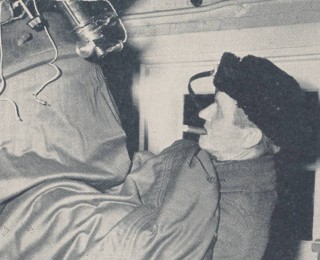
Caption: H. A. Sawyer loading plates into the Harvard 16” Metcalf Doublet telescope. Picture from http://hea-www.harvard.edu/DASCH/telescopes.php Paper Title: 100-year DASCH Light Curves of Kepler Planet-Candidate Host Stars Authors: S. Tang et al First Author’s Affiliation: Harvard-Smithsonian Center for Astrophysics, Cambridge, MA; Kavli Institute for Theoretical Physics, Santa Barbara, CA; California Institute of Technology, Pasadena, CA Journal: Publications of the Astronomical Society of the Pacific (Submitted) Introduction: the DASCH projectAstronomy has advanced in leaps and bounds over the last few hundred years. Perhaps the single greatest advance has been the switch from observing with our eyes to observing with cameras. Where once we inspected the heavens with our eyes and relied on sketches to record what we saw, now we attach imaging mechanisms directly to the telescope. Not only does this allow us to collect more photons, imaging mechanisms also give us the ability to store data for later analysis. A little more than a century ago, astronomers at Harvard made the switch to using photographic plates to image the heavens. Each plate, once analyzed, was cataloged, archived, and forgotten…until now.Researchers at Harvard recently recognized the promise of the data being held in these archives. Over a century’s worth of observations of the sky are recorded in these plates. By contrast, most objects observed as part of other projects have no more than a few decades worth of observations at best. This dataset offers us the remarkable opportunity to study how stars have evolved over almost a century. Who knows what long-term trends or cycles might be identified?To realize the potential of this dataset and answer questions like these, the...
by Kim Phifer | Oct 5, 2012 | Daily Paper Summaries
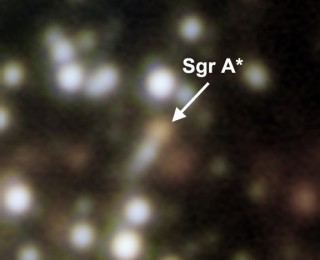
Witzel et. al examine the statistical properties of the photometric variability of our Galaxy’s central black hole.
