by Yvette Cendes | Nov 22, 2013 | Daily Paper Summaries
Title: Evidence of an Asteroid Encountering a Pulsar Authors: P. R. Brook, A. Karastergiou, S. Buchner, S. J. Roberts, M. J. Keith, S. Johnson, R. M. Shannon First Author’s Institution: University of Oxford Pulsars- neutron stars formed during supernovae explosions- are often considered the “precision clocks” of radio astronomy. This is because of two fundamental properties observed from their radio pulses: the average emitted radio beam- known as the pulse profile– remains very stable over decades, and the pulsar has extreme rotational stability thanks to its fast rotation. All pulsars have a rotational frequency, ν, which is gradually decreasing due to a loss of energy, and its change with time, the spin-down rate, tells radio astronomers about the stability of the pulsar. Hundreds of pulsars have been observed to have glitches where the pulsar’s rotational frequency is seen to increase rapidly, and there have even been anti-glitch observations where the pulsar abruptly slowed down, which are thought to be caused by the magnetic fields of the pulsar.But the interesting thing about astronomy is even in a field where things are as precise as pulsars, surprises will still crop up. And this is what happened during a 24-year observing campaign of PSR J0738-4042, when in September 2005 the spin-down rate abruptly changed and a new radio component was observed. In fact, no previously understood mechanism can explain these changes, and the observations led the paper’s authors to propose they witnessed an asteroid encountering the pulsar.The observations were relatively straightforward: PSR J0738-4042 is a bright radio pulsar and was the target of a monitoring campaign by the Hartebeesthoek Radio Astronomy Observatory (HartRAO) in South...
by Andrew Emerick | Nov 18, 2013 | Daily Paper Summaries
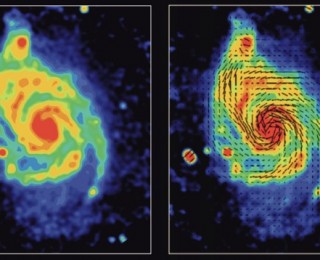
Magnetic fields are ubiquitous in the Universe. Everything including stars, solar systems, galaxies, galaxy clusters, and even large scale voids have magnetic fields. We know magnetic fields exist in the Universe, but have had a challenging time uncovering both their origin and evolution. Today’s astrobite discusses a recent paper exploring how magnetic fields evolved in young galaxies through computational simulations. It is one step further in unlocking the history of magnetic fields in our Universe.
by Elizabeth Lovegrove | Oct 28, 2013 | Daily Paper Summaries
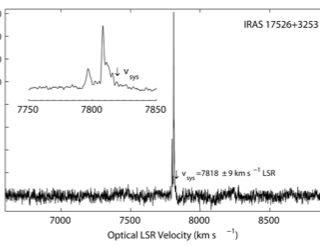
Giant clouds of molecules in space provide the gain material for astrophysical masers, emitting microwave radiation by stimulated emission. These bright sources can be used to determine extragalactic distances and black hole masses. This paper reports on a search for new extragalactic water masers with the Very Long Baseline Array, and reports on the discovery of four sources in 37 objects searched.
by Elisa Chisari | Oct 16, 2013 | Daily Paper Summaries
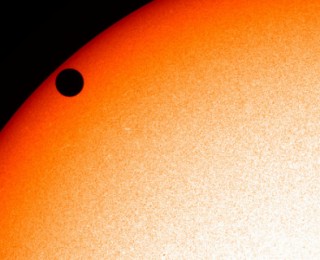
We are used to thinking about planet transits in visible wavelengths. What can we learn from planet transits in the radio band? Today, we discuss what these transits might tell us about the magnetic activity and the atmosphere of a star.
by Josh Fuchs | Sep 5, 2013 | Daily Paper Summaries
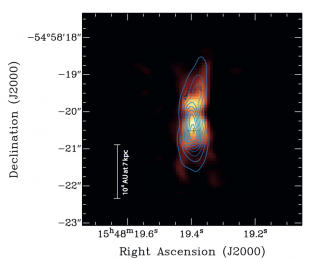
The authors present the first direct evidence of a jet shaping the circumstellar envelope of a post-AGB star.
by Jessica Donaldson | Aug 7, 2013 | Daily Paper Summaries
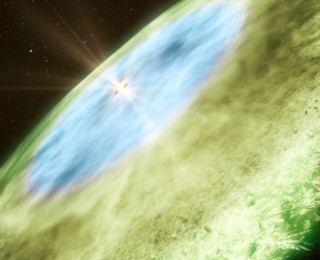
Astronomers imaged a snow line in a protoplanetary disk with ALMA – a step towards a better understanding of the theory of planet formation.
