by Evan Schneider | Mar 20, 2012 | Daily Paper Summaries
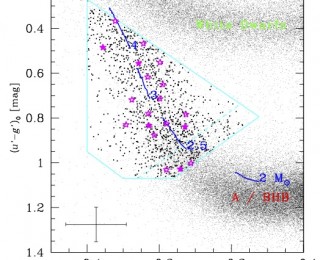
Five new hypervelocity stars have been discovered in the outer regions of the Milky Way. In this paper, the authors discuss what these stars are, how they got so far away, and what their distribution implies about the center of our galaxy.

by Kim Phifer | Mar 11, 2012 | Daily Paper Summaries
Rebassa-Mansergas et al. investigate two long period post common envelope systems in order to place constraints on the energy budget for common envelope evolution.
by Courtney Dressing | Feb 2, 2012 | Daily Paper Summaries
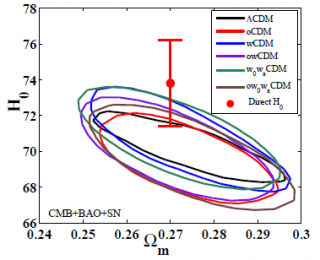
In this series of papers, the authors apply new analysis techniques to data from several galaxy redshift surveys to uncover acoustic waves from the early universe and refine measurements of cosmological parameters.
by Guest | Jan 8, 2012 | Career Navigation
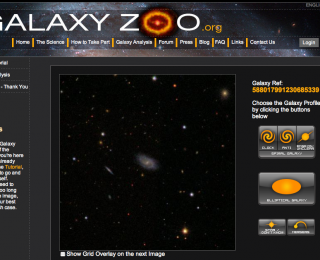
Kevin Schawinski of Yale University, co-founder of the Galaxy Zoo project, explains how to use crowd sourcing to make sense of enormous data sets.
by Nathan Goldbaum | Dec 2, 2011 | Daily Paper Summaries
It is written in The Standard Lore of Astronomy – a leather-bound book professors keep under their desks – that stars in the disks of spiral galaxies have a bimodal distribution of scale heights. Today we will be discussing a paper that comes to the conclusion that the notion of a thick disk and a thin disk is actually a poor approximation to the true distribution of disk stars.
by Ian Czekala | Nov 17, 2011 | Daily Paper Summaries
I’m sure you’ve heard the expression “5 hours in the library can save 5 months in the lab.” It’s true. Productive scientists are aware of what other scientists have done before them, that way they may “stand on the shoulders of giants” so that they might see farther. Linking datasets to papers improves the usability of previously published research and is one major way to increase the overall productivity of the scientific field.
