
Meet the Keynote Speakers: Rebekah Dawson
In this series of posts, we sit down with a few of the keynote speakers of the 230th AAS meeting to learn more about them and their research.

In this series of posts, we sit down with a few of the keynote speakers of the 230th AAS meeting to learn more about them and their research.
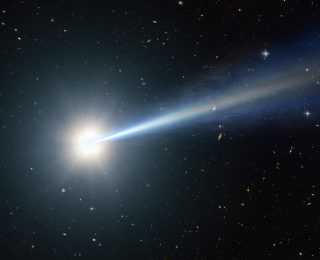
When it comes to habitability for Earth-like life, we’ve got more than just liquid water to worry about. Today’s astrobite looks at how planets could lose portions of their atmospheres to quasar radiation.
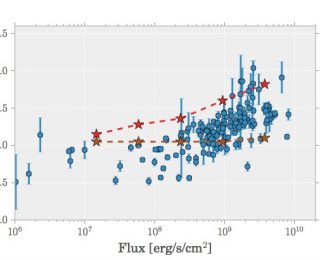
Hot Jupiters passively cool down and contract after formation. Standard models can predict their thermal history and how much their radii should contract up to present time. Yet the observed radii (e.g. through transit) are larger than prediction. The possible solutions to this problem can be categorized into two types: (I) constantly injecting energy into the interior (II) delay the cooling process. (I) includes downward transport of kinetic energy, or energy dissipated by the interaction with the magnetic field (ohmic dissipation). Enhanced opacities are also proposed to reduces the cooling rate, which belongs to (II). However, the above mechanisms are either not robust or restricted to fine-tuned parameters. So the radius anomaly remains an intriguing open problem.
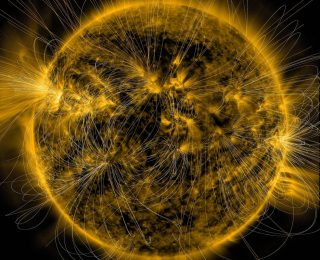
Many celestial bodies show magnetic fields, from the Earth to the faint white dwarf stars. Is there a common explanation for such fields?
Image credits: NASA/SDO/AIA/LMSAL
They ruled the UV skies… or did they?
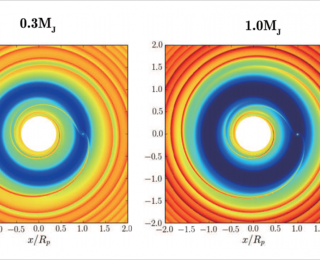
Characterizing planets through direct imaging is no easy task! But today’s authors offer a work-around formula, which estimates the crucial parameter of planetary mass from protoplanetary disk observations. In this astrobite, we discuss ‘The Theory’ and ‘The Practice’ of their cool equation.