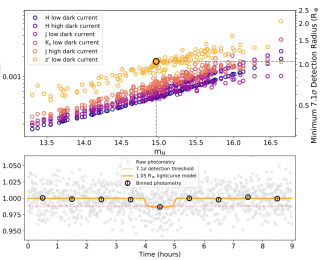
A step by step guide to finding planets around ultracool dwarfs
Astronomers have been finding planets around M dwarf stars for a while. Can we go even cooler and find planets around the diverse L and T spectral group?

Astronomers have been finding planets around M dwarf stars for a while. Can we go even cooler and find planets around the diverse L and T spectral group?
Most Jupiter-like exoplanets go undetected. But do they leave a mark on the more easily detectable inner terrestrial worlds?
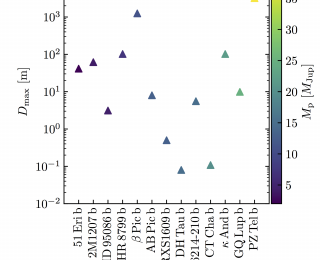
The absence of dusty circumplanetary disks around young giant planets suggests moonetesimals grow relatively quickly.
Observations from Hubble and Spitzer bring us one step closer to understanding the atmospheric compositions of intermediate-mass exoplanets.
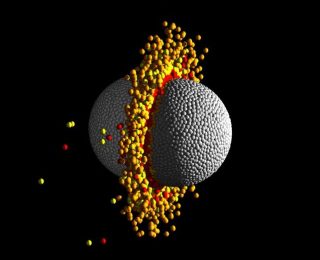
Interplanetary collisions can explain a number of phenomena in our own solar system — here’s evidence of such a crash shaping the formation of two distant planets. Translate from an Astrobitos bite by Elena Gonzales Egea.
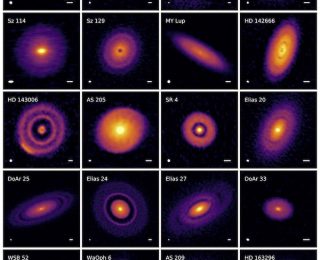
To understand planet formation, we need to observe newborn planets that are in their earlier stages of development. This is exactly what was discovered around PDS 70 – the first young, forming planet around a protostar of this age. Read more to learn about what we saw, and how we got that data!