by Philippa Cole | Mar 20, 2019 | Daily Paper Summaries
Gravitational waves are distorted by the objects that lie in their wake – how can we learn more about their journey through the cosmos?
by Haley Wahl | Feb 21, 2019 | Daily Paper Summaries
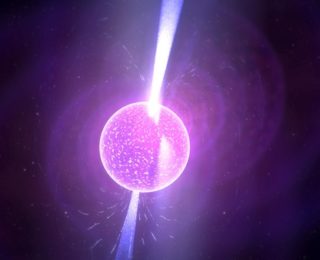
Learn more about how the NANOGrav team is searching for gravitational waves using cosmic lighthouses!
by Aaron Tohuvavohu | Jan 18, 2019 | Daily Paper Summaries
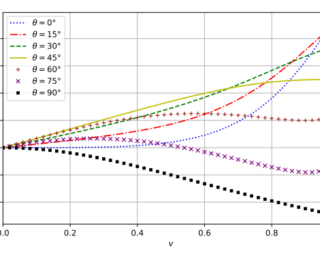
Title: Detecting the Beaming Effect of Gravitational WavesAuthors: Alejandro Torres-Orjuela, Xian Chen, Zhoujian Cao, and Pau Amaro-SeoaneFirst Author’s Institution: Kavli Institute for Astronomy and Astrophysics at Peking University, Beijing, ChinaStatus: Published in Phys Rev D, open access The direct detection of compact binary mergers like binary black hole and binary neutron star systems via their gravitational radiation have come via decades of development in inteferometric detector technology and data analysis techniques. One of the most important components to the success of the enterprise has been the breakthrough achievements in numerical relativity, which is necessary to reproduce the inspiral, merger, and ringdown gravitational waveforms produced in compact binary mergers and produce template waveform banks for comparison with the data. However, these numerical relativity simulations are computationally expensive, which limits template banks to use component masses and spins of the compact objects, instead of a larger battery of parameters. The authors of today’s paper argue that another component, the velocity of the source relative to the observer (us), can have a substantial impact on the inferred gravitational wave amplitude. The Doppler shift induced by the component of relative motion towards or away from the observer is well known. A less known phenomenon, though well studied for the electromagnetic case, is the beaming effect. The beaming effect, also known as doppler boosting or the headlight effect, describes a scenario wherein the relative motion of a source can induce a change in the apparent luminosity of its radiation. For the case of gravitational radiation the analogous effect is a deviation in the apparent (observed) amplitude of the gravitational wave relative to the intrinsic...
by Stephanie (Hamilton) Deppe | Jan 2, 2019 | Current Events
The first binary neutron star detection was a true team effort between thousands of scientists. The Fermi Gamma-ray Burst Monitor and its Principal Investigator, Dr. Wilson-Hodge, played a crucial role — check out her plenary talk at #AAS233 to learn more!
by Astrobites | Oct 30, 2018 | Daily Paper Summaries
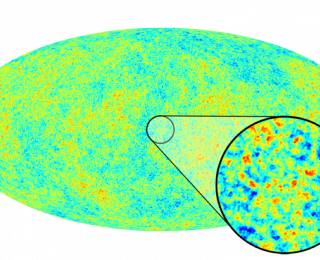
Scientists can use neural networks to glimpse gravitational wave fluctuations from the early universe.
by Lisa Drummond | Oct 5, 2018 | Daily Paper Summaries
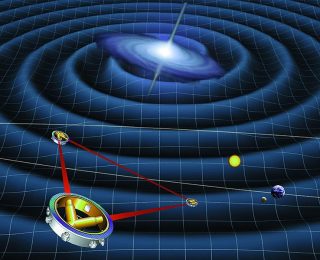
We can use forewarnings from future space-based detector LISA to improve LIGO detections.
