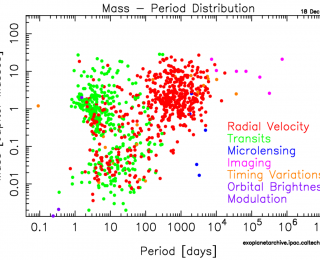
The Radial Velocity Method: Current and Future Prospects
Much of what we know today about exoplanets is due to the success of the radial velocity method. Where does it stand now? What is its future?

Much of what we know today about exoplanets is due to the success of the radial velocity method. Where does it stand now? What is its future?
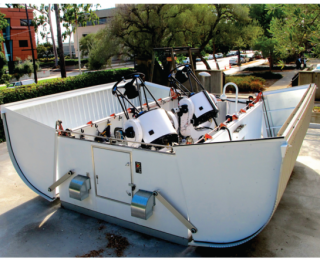
MINERVA: Detecting Super-Earths from the ground in a modular, cost-effective manner.
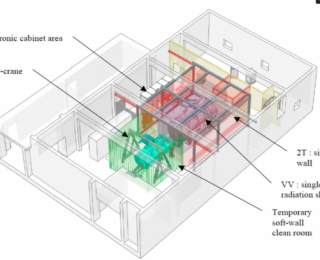
Are you on the lookout to see if there are habitable planets are out there? Or do you want to see how or if physical ‘constants’ have varied with time? Why not design a versatile instrument capable at tackling a wealth of outstanding questions in astronomy: a sort of a “scientific pandora’s box” for extremely high precision astronomical research? This is where ESPRESSO comes in…
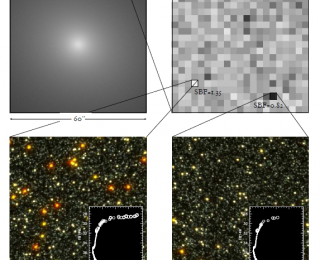
Astronomers use models to derive properties of individual stars that we cannot directly observe, such as mass, age, and radius. This is also the case for a group of stars (a galaxy or a star cluster). One problem with current stellar population models is that they remain untested for old populations of stars. The authors of this paper devise a new way to test models of old stellar populations.
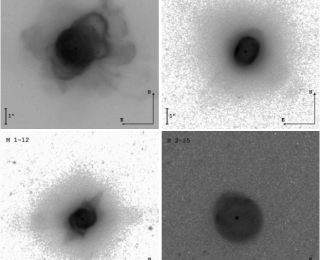
Sometimes, stellar evolution happens on more human timescales—tens to hundreds of years rather than millions or billions.
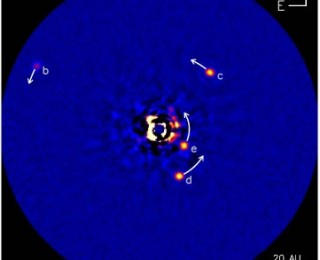
The authors break in the new Gemini Planet Imager with spectroscopy of the well-studied but not yet well-explained exoplanets HR 8799 c and d.