Astrophysical Classics: A Burst of Inspiration
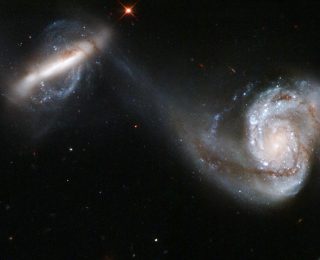
The year is 1978. Some people are wondering how star formation works in weird-looking galaxies.

The year is 1978. Some people are wondering how star formation works in weird-looking galaxies.
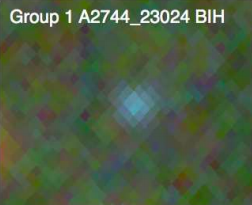
Today’s paper suggests that globular clusters might come from a newly-discovered class of low-mass galaxies called “Little Blue Dots.” And even if you don’t care about globular clusters, you should read this post anyway to learn about some weird names for different types of galaxies.
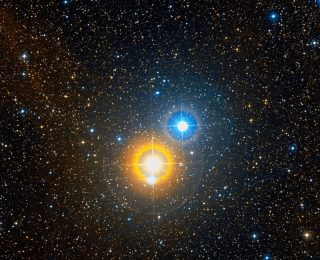
The fraction of binary stars has implications in many fields of astronomy. Yet, we still don’t know this number, and even less how it varies with properties such as metallicity. Today’s paper sheds some light on this open question.
Image credits: Palomar Observatory/STScI/WikiSky

We understand cosmology by building models that we can trace back through time, but nothing about these models limits them to the past. As the universe expands, faster and faster pushed by dark energy, when does that acceleration outstrip gravity? And when do the last stars form?
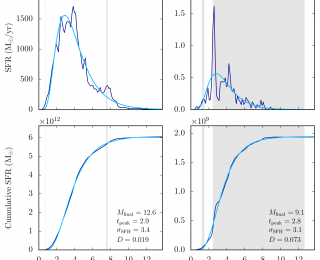
Every galaxies star formation history is a story waiting to be told. Turns out log-normals cover most story lines.
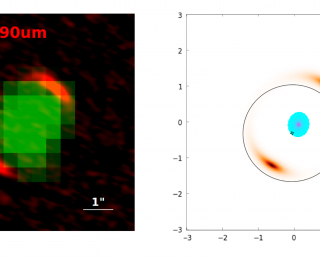
Today’s paper uses gravitational lensing to find a dusty starburst galaxy so far away that it existed when the universe was less than a billion years old.