by Elisabeth Newton | Sep 28, 2011 | Daily Paper Summaries
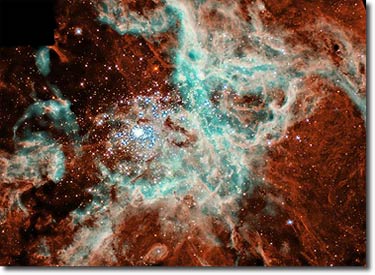
Stars form in environments that are characterized by vastly different densities, pressures and metal content. Yet the sizes of the stars formed don’t vary substantially (as measured by the median mass). Why don’t the properties of the clouds out of which stars fragment have a stronger influence on the result? Why is there a characteristic stellar mass? Why is this mass scale similar to that for nuclear burning (the process that fuels stars)?
(photo: NASA via LANL, https://www.llnl.gov/news/newsreleases/2005/NR-05-11-10.html)
by Maria Drout | Aug 24, 2011 | Daily Paper Summaries
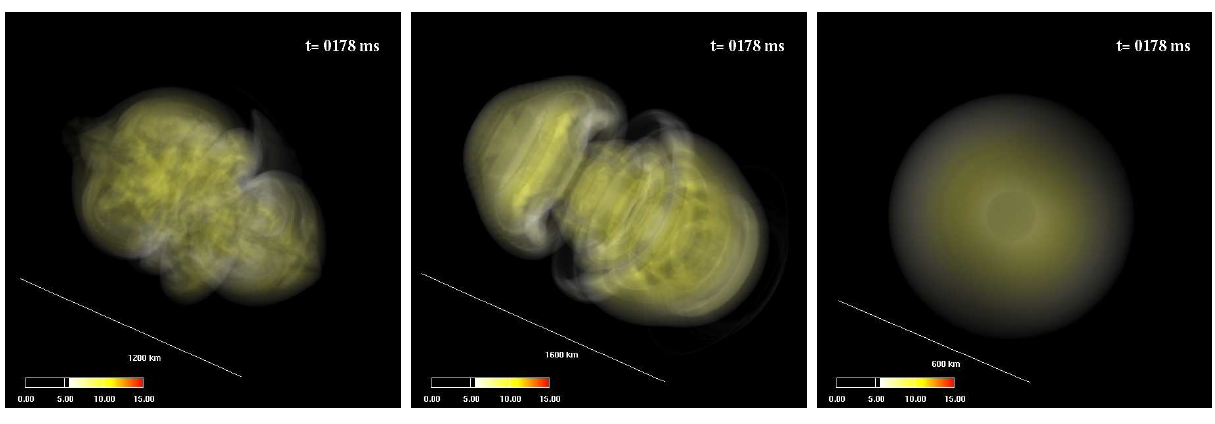
Three-dimensional Hydrodynamic Core-Collapse Supernova Simulations for a 11.2 M⊙ Star with Spectral Neutrino Transport Tomoya Takiwaki, Kei Kotake, Yudai Suwa First author’s institution: Center for Computational Astrophysics, National Astronomical Observatory of Japan Core-collapse supernovae are some of the most energetic explosions in the universe and astronomers have devoted an incredible amount of both brain power and computational power to unraveling this astrophysical phenomenon. Despite this fact, the problem is far from solved.The ‘standard model’ for these explosions begins when a star with an initial mass greater than ~8 solar masses has progressed through a series of nuclear fusion processes in its core, culminating in the burning of silicon into iron-56. At this stage, fusion can proceed no further and the outward pressure supplied by the energy produced during nuclear burning ceases. If the overlying star is massive enough, the core will be unable to support itself and begins to collapse. In this high energy environment photodisintegration (effectively the reverse of nuclear fusion) and electron capture convert the iron core into free neutrons. When the core reaches approximately nuclear density, pressure exerted by the strong nuclear force and neutron degeneracy cause the collapse to halt. The remaining infalling matter then “bounces” off the proto-neutron star, causing an outward propagating shock wave.Ok, now hang with me. This is where it starts to get complicated… Simulations indicate that this initial shock is NOT what causes the supernova explosions we observe. Rather, additional photodisintegration and neutrino release cause the wave to lose energy and halt after less than a second. This produces a “standing shock” approximately 150 km from the proto-neutron star. In order...
by Nathan Sanders | Aug 22, 2011 | Daily Paper Summaries
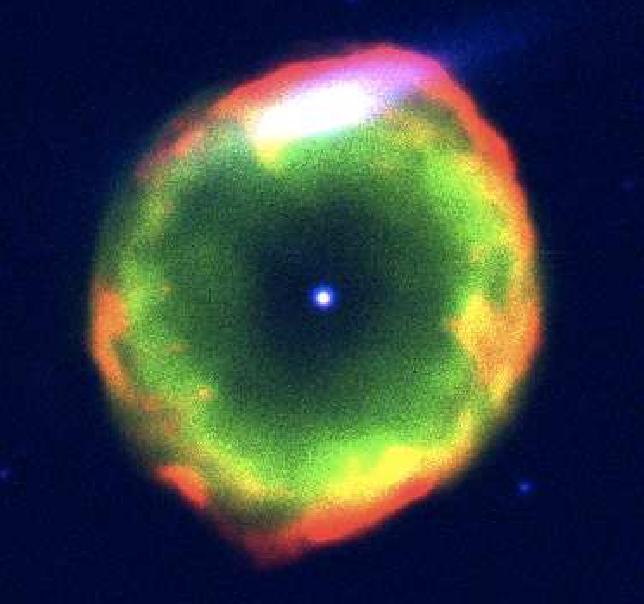
Miszalski et al. show that the well-known planetary nebula Abell 70 has a white dwarf companion at its center with a messy past.
by Elisabeth Newton | Aug 17, 2011 | Daily Paper Summaries
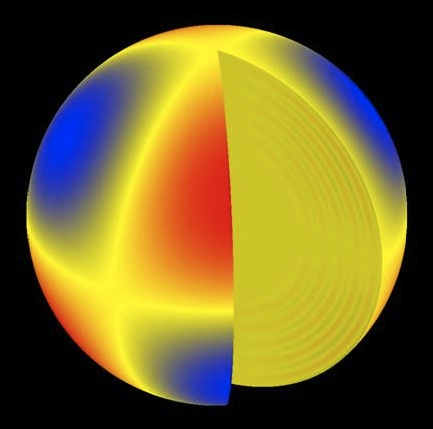
If there’s one type of star you’d think astronomers would know a lot about, it’s probably solar-type stars. After all, humans have been staring at our very near neighbor for millennia and in the recent century have dedicated entire space missions to studying this archetype. But there is always more to be learned and new tools like asteroseismology continue to open up avenues of study previously closed.
by Ian Czekala | Aug 4, 2011 | Daily Paper Summaries
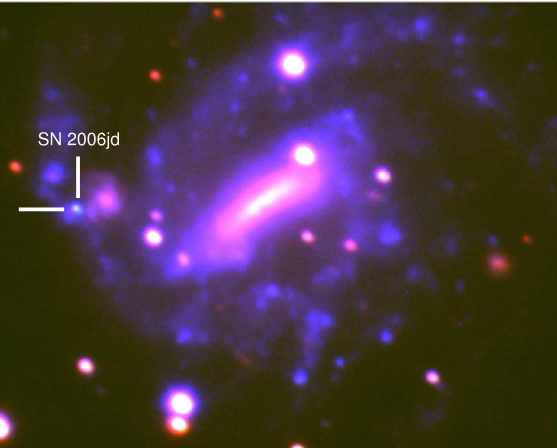
Many astronomers have an ambivalent relationship towards “dust” in our cosmos. Not quite like what you may find at the back of your cupboard, astrophysical dust is really more like smoke, with particulates roughly micron-sized and composed of carbon, nitrogen, oxygen, silicon, and other things that astronomers broadly term “metals.” Some of the best candidate sites for dust formation include cool stellar winds from evolved stars, and in the aftermath of supernovae and novae.
by Elisabeth Newton | Jul 21, 2011 | Daily Paper Summaries
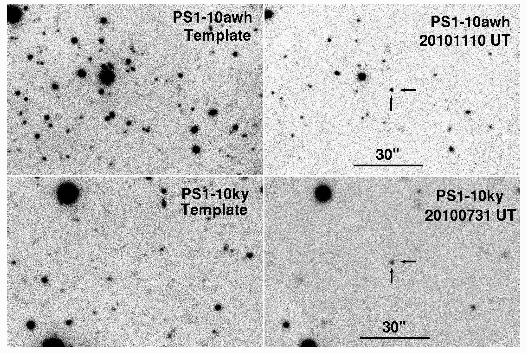
Starting in 2005 with SN 2005ap, astronomers began to detect new transients that are far more luminous than previously-known supernovae. With brightnesses ten times those seen in Type 1a’s, these new supernovae have been dubbed “ultraluminous supernovae.” This paper presents two new supernovae discovered by Pan-STARRS.
