by Tim Lichtenberg | Feb 6, 2015 | Daily Paper Summaries
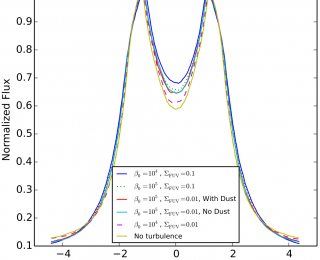
Why do planetary disks fade away so fast? A leading candidate as villain in this story is turbulence. Using the combined strengths of sophisticated theoretical models and observations, we might be able to find out if this is true!

by Michael Küffmeier | Jan 13, 2015 | Daily Paper Summaries
Magnetic fields are a crucial part of star formation. Read on whether and how the magnetic field strength dissipates during the early collapsing phase.
by Tim Lichtenberg | Jan 2, 2015 | Daily Paper Summaries
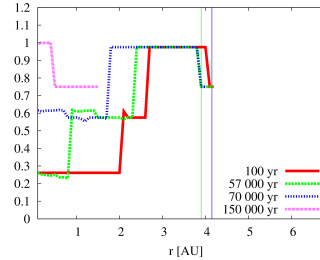
The recent discoveries of alien worlds seemingly rich in carbon reveal a lot of diverse information about the history and further evolutionary paths of exoplanets. However, a correct physical understanding of the investigated systems is crucial for getting the most out of incoming data and is an area of very active research. Therefore, the theoretical modeling of exoplanetary systems must be advanced to a state which includes the long-term evolution of the distribution of detectable molecular species in the planet forming environment.

by Ashley Villar | Dec 30, 2014 | Daily Paper Summaries
Dark matter, neutron stars, black holes, and an extremely exotic explanation for Fast Radio Bursts.
by Tim Lichtenberg | Dec 3, 2014 | Daily Paper Summaries
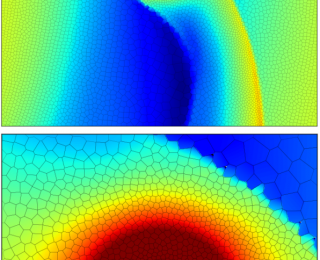
Only the combined effort of observational and theoretical methods can really bring us to a more thorough understanding of the Universe throughout all spatial scales. The authors of today’s paper use and adapt the moving-mesh fluid mechanics code AREPO to function with protoplanetary disks and test its imprint on the potential of planets to open up gaps in the surrounding gas.
by Josh Fuchs | Oct 28, 2014 | Daily Paper Summaries
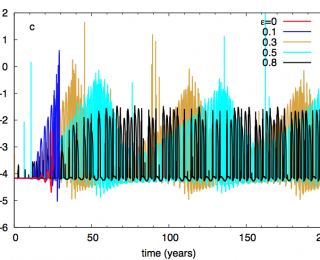
How do the most massive stars explode? A new model of massive stars predicts new observational evidence.
