
by Maria Drout | Sep 8, 2011 | Career Navigation, Daily Paper Summaries
Title: Astronomy Career Profiles from the AAS Newsletter Archives Authors: Travis Metcalfe, Leila Belkora, Liam McDaid, Blake Bullock, Christine Pulliam, Peter Williams, Joshua Roth, Barb Whitney, Knut Olsen, Andy Howell, Luke Keller For those of you who feel like you have your life and your future completely figured out, I apologize in advance for this post. But ‘tis the season: the beginning of a new academic year, the time when many of you may be thinking about the next stage in your careers. Dan already wrote two fantastic posts this week about the process of applying to graduate school (here and here) but now I want to take a step back.Going to graduate school is a large commitment, and making the decision to do so can be a stressful process. In astronomy, in particular, I have encountered numerous students plagued by a series of ‘what ifs’, all of which seem to stem from a basic misconception about what going to astronomy graduate school actually means for your future.To help frame this misconception, I pose the following question to all of you thinking of pursuing astronomy, “What’s the point?” This may seem like a very philosophical question, and it is, but I guarantee that at some point in your career you will be asked to justify what you do to a “layman”. So start working on your answer now. And let me warn you: it is quite frankly harder in astronomy than some other sciences. Although space cowboys on asteroids are pretty cool, it is my opinion that we can’t really just default to, “some day this research will save...

by Evan Schneider | Sep 7, 2011 | Daily Paper Summaries
In this paper, the authors describe a new class of quasar which pushes the boundaries of our current understanding of black hole physiology.
by Elizabeth Lovegrove | Sep 5, 2011 | Daily Paper Summaries
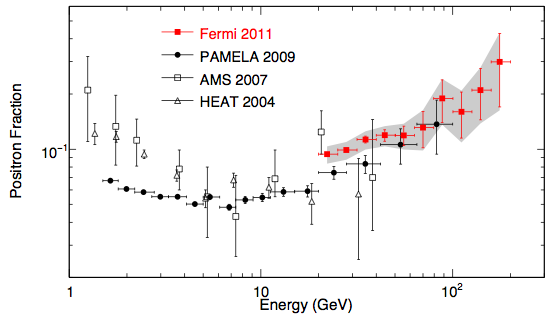
The Fermi Large Area Telescope used a clever method of splitting electrons and positrons via the Earth’s magnetic field to show that there’s a significant excess of cosmic ray positrons at high energies – much more than can be explained using known cosmic ray processes.
by Courtney Dressing | Sep 1, 2011 | Daily Paper Summaries
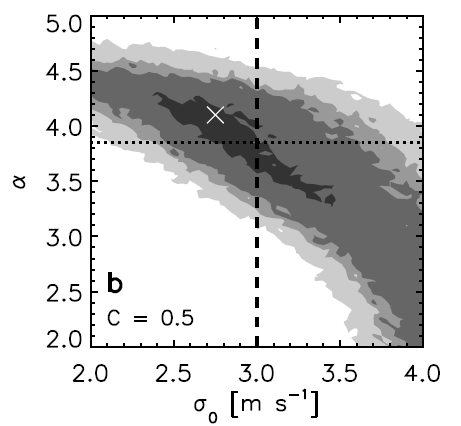
How do the planet candidates discovered by Kepler compare to the planets detected by radial velocity surveys? Can we combine the Kepler radii with the RV masses to determine whether small planets are rocky Super-Earths or gaseous mini-Neptunes?
by Adele Plunkett | Aug 31, 2011 | Daily Paper Summaries
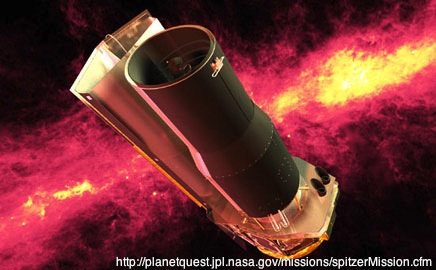
Many aspects of the star forming process, especially the process to form massive stars (greater than 8 solar masses), remain unknown. This paper distinguishes between two stages of star formation by fitting models to observations of several young stellar objects in the giant molecular cloud G333.
by Nathan Goldbaum | Aug 30, 2011 | Daily Paper Summaries
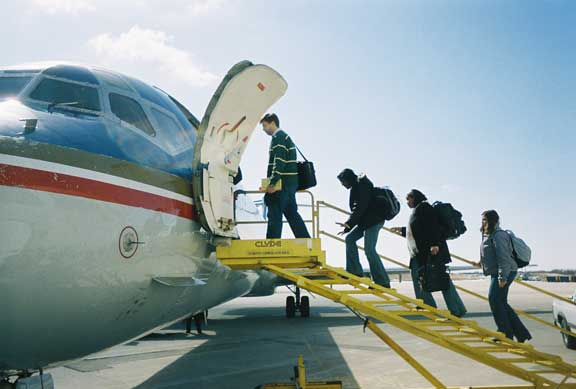
• Title: Experimental test of airplane boarding methods • Authors: John H. Steffen, Jon Hitchkiss • First Author’s Institution: Fermilab Center for Particle AstrophysicsToday’s astrobite doesn’t have much to do with astronomy. In fact, at yesterday’s morning coffee discussion here at UCSC, there was a bit of surprise that this particular paper was cross-listed to the astrophysics section of arxiv.org at all. I guess the authors know that astronomers tend to spend an unusually large fraction of their lives in airplane cabins, so it would be worthwhile to notify us of the latest developments in the science of air travel.The question this paper would like to answer is a deceptively simple one: what is the optimal way to board an airplane? As the answer to this particular question can save airlines money, a significant amount of effort has already been expended on computational models of airplane boarding. In 2008, the lead author of this study published a candidate for the holy grail of the field: the optimum boarding strategy. Here, the authors experimentally verify whether the boarding procedure worked out by Steffen in 2008 is truly the optimum boarding strategy.There are two types of inefficiency in airplane boarding. The first, called aisle interference, happens when passengers stop in the aisle to put away their luggage. The second, called seat interference, happens when a passenger has to wait for another passenger in their row to sit down before they can enter the row. Seat interferences don’t necessarily impact boarding time, but they can cause aisle interferences, which do increase boarding time. Different boarding methods entail different tradeoffs between the number...
