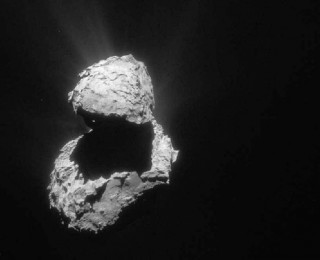
by Michael Küffmeier | Dec 2, 2015 | Daily Paper Summaries, Guides
More than a year ago, scientists managed to land on a comet for the very first time in human history. Read on to get a compact overview of some of the most important results of the mission obtained so far.

by Michael Küffmeier | Oct 7, 2015 | Guides
Astronomy & astrophysics is certainly an exciting field of research, but imagine there is a lot of research in other fields as well. How has research across different disciplines evolved in the past and how will astrophysics & astronomy do in terms of interdisciplinarity in the future?
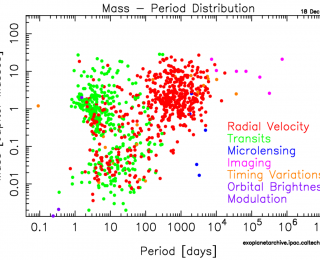
by Gudmundur Stefansson | Mar 23, 2015 | Current Events, Guides
Much of what we know today about exoplanets is due to the success of the radial velocity method. Where does it stand now? What is its future?
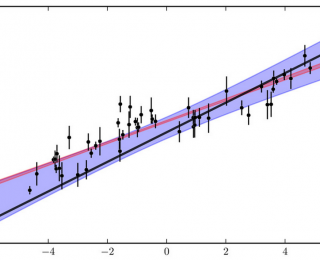
by Ben Montet | Jul 1, 2014 | Guides
A common measure of the quality of a fit is the chi-squared statistic. While common, implementation of this statistic assumes uncorrelated noise, which is much less common. Today, we discuss how to deal with noise that is correlated and why it’s important.
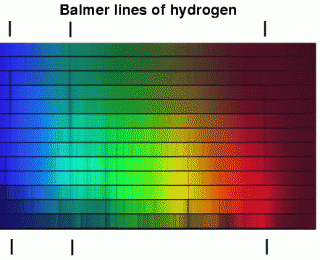
by Ben Montet | May 6, 2014 | Guides
Let’s face it: some astronomical systems don’t make any sense. Join us for a look at the history of some of these terms, as we try to understand why stellar spectral classification and the magnitude system work like they do.
by Elizabeth Lovegrove | Jul 28, 2013 | Guides
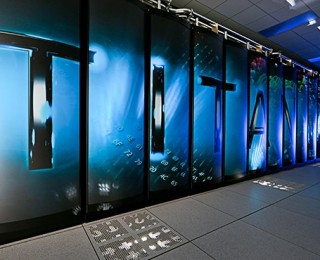
Computational physicists are already looking to the next milestone on the horizon: exascale computing, or supercomputers whose performance peaks in the exaflop range. But we need to get a lot better at parallelization before we can successfully compute at the exascale level.
