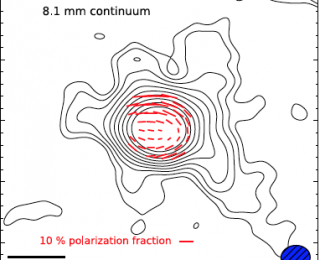
by Michael Zevin | Nov 17, 2015 | Daily Paper Summaries
Magnetic fields are believed to play an integral role in the formation of stars and protoplanetary disks. Today’s article took the one of the closest looks ever at the magnetic field around a baby star and unveiled its underlying structure.
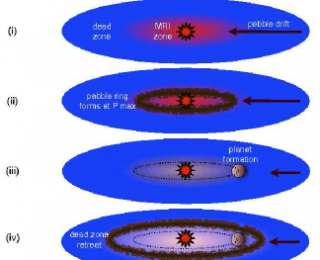
by Michael Küffmeier | Nov 4, 2015 | Daily Paper Summaries
Planets with radii between Earth and Neptune and small radii are the most common in planetary systems. These planets are challenging to explain with classical models of planets. Do planets form instead in-situ in an inside-out manner?

by Tim Lichtenberg | Nov 2, 2015 | Daily Paper Summaries
Earth’s composition seemingly does not fit into planet formation theory. Ripping apart its building blocks by collisions during accretion might sound violent, but can be a way to go.
by Guest | Oct 27, 2015 | Daily Paper Summaries
More than 100 massive stars orbit the supermassive black hole at the center of our galaxy incredibly closely.
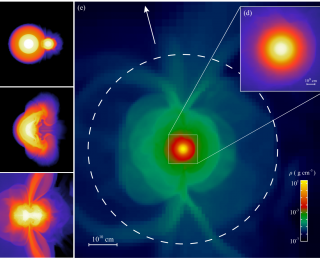
by Tim Lichtenberg | Oct 5, 2015 | Daily Paper Summaries
A dry planet and one with a thick atmosphere close together seems to be very weird. How about smashing one with a huge impactor?
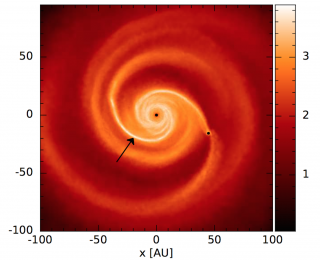
by Tim Lichtenberg | Sep 15, 2015 | Daily Paper Summaries
How to form clumps in the intermediate ranges of massive protoplanetary disks? Could these later be planets?
